


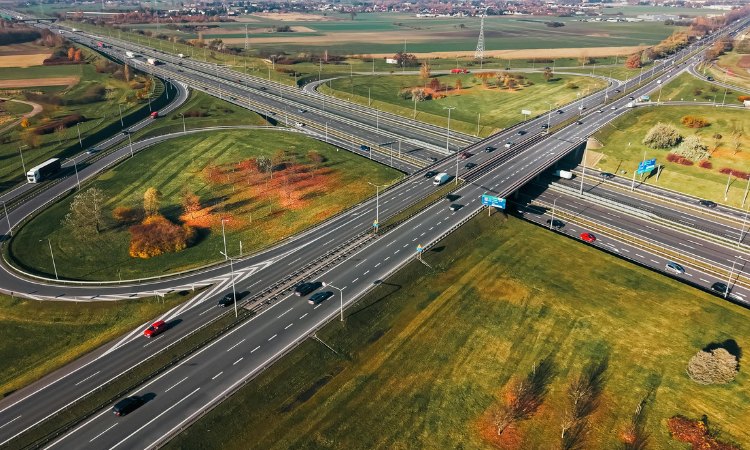
The Delhi-Mumbai Expressway is India’s most determined by-road travel infrastructure project in modern days. It is designed to radically reduce travel time between the national capital Delhi and the financial powerhouse Mumbai, this limited-access expressway promises to redefine connectivity, trade, and transportation across six states – Haryana, Rajasthan, Madhya Pradesh, Gujarat, Maharashtra, and the Union Territory of Delhi.
Once the expressway is fully operational, it will reduce current travel durations to almost half, enhance area-wide development, and create smooth logistical routes that will connect India’s heart Delhi with main port and trade centres.
The way people choose to move their families and goods across the country is already changing because of its strategic plans. In this article, we will explore the Delhi Mumbai Expressway route map, project cost, Completion Date, Toll Rates, and more details. So, let us start this blog.
Delhi Mumbai Expressway Overview
| Total Lane | 8 lanes (expandable to 12 lanes) |
| Type | Greenfield Access-Controlled Expressway |
| Total Length | Approx. 1,386 km |
| Starting Point | Sohna / Delhi NCR |
| Ending Point | Mumbai (JNPT / Virar region) |
| Speed Limit | Up to 120 km/h |
| Developer | National Highways Authority of India (NHAI) |
| Current Status | Partially Opened |
| Completion Date | June 2026 (Expected) |
| Project Cost | Approx. ₹1 lakh crore |
Delhi Mumbai Expressway Route
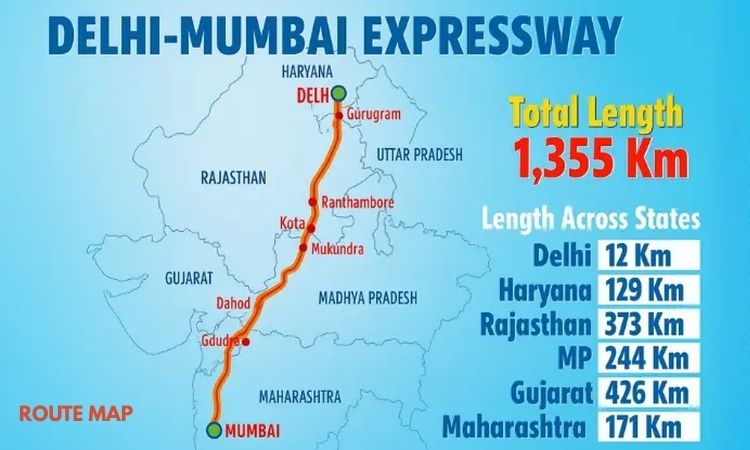
The Delhi Mumbai Expressway route is approximately 1,350-1,386 kilometres long and planned as an eight-lane highway (expandable to 12 lanes). This expressway begins at the DND Flyway in Delhi and concludes at the Jawaharlal Nehru Port Trust (JNPT) in the Mumbai Metropolitan Region, which is considered as India’s busiest port. The foundation of this project is laid by Union Minister Shri Nitin Gadkari Ji on 9 March 2019.
Delhi Mumbai Expressway route will cover 5 different states such as Haryana, Rajasthan, Madhya Pradesh, Gujarat and Maharashtra. After its completion, it will reduce the time travel between Delhi and Mumbai by 12 hours.
This route will cover 129km in Haryana, 373 km in Rajasthan, 244 km in Madhya Pradesh, 426 km in Gujarat and 171 km in Maharashtra.
It also integrates primary branch routes and junctions such as linkage to Jewar Airport (Noida) and additional routes toward major urban hubs.
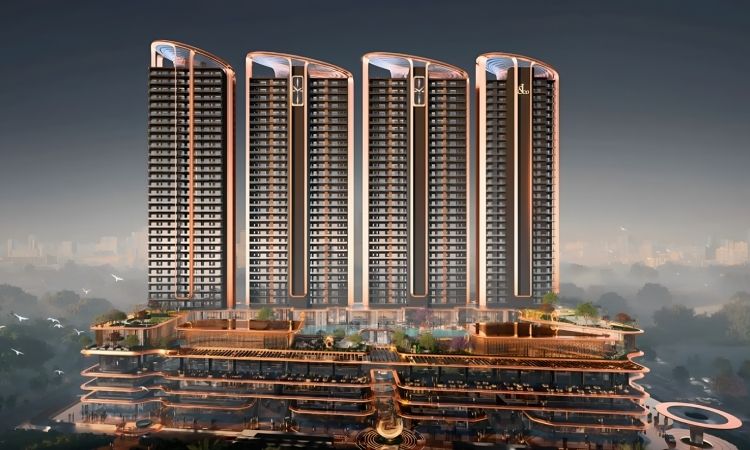
Explore Top Residential Projects Near Delhi-Mumbai Expressway
| Projects | Location |
| Signature Daxin Vistas | Sohna Road, South Gurgaon |
| Ashiana Mulberry Moments | Sohna Road, South Gurgaon |
| Signature Global Park 4 & 5 | Sector-36, Sohna |
| Central Park Orchard | Sohna, South Gurgaon |
Delhi Mumbai Expressway Route Map
This greenfield access-controlled expressway will connect to National Capital Delhi with Financial Capital of India, Mumbai. Mumbai Delhi Expressway route map will cover five different states as discussed above.
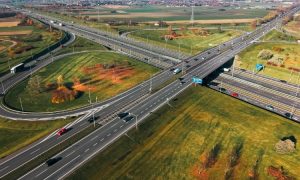
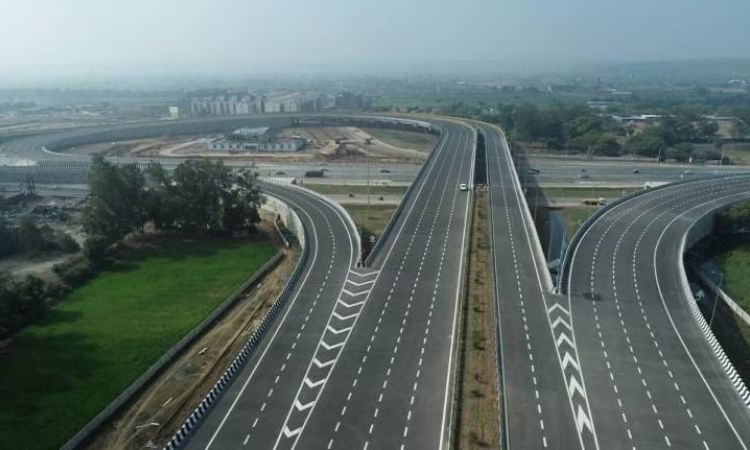
Delhi-Mumbai Expressway Actual Images
Delhi Mumbai Expressway Current Status and Completion Date
The inauguration was done in phases as it moved through cities across multiple states. The first operational segment (Sohna-Dausa) ready for traffic was in February 2023.
According to the Union Minister, this part of the Delhi-Mumbai Expressway is completed. Around 1150-1136km has been fully operational out of 1386km, and the remaining part will be completed by June 2026 to 2027. Overall, this expressway is 90% complete, and the Government is trying to complete this expressway by June 2026 to 2027.
Mumbai Delhi Expressway: Progress and Status As of 2025-2026
- Partially functional: Hundreds of kilometers (for example Sohna-Dausa and some areas in Madhya Pradesh and some of Gujrat) are now open for traffic.
- Over 80–83% of the construction work is completed as of late 2025.
- Particular smaller linking routes (such as a 9 km road near Delhi) are expected to open by mid-2026.
- According to multiple records and many authorities, the expressway is anticipated to be fully functional by early 2026 to somewhat mid-2026. However, some stretches might take up to 2027 to complete.
When announced it was scheduled to complete around October 2025, but ongoing delays have shifted expectations, now some authorities are hoping it to be fully functional in mid-2026. In case of mega-infrastructures like this expressway, such mixed and delayed timelines are common because of its changing nature and diverse jurisdictions.
Delhi Mumbai Expressway Toll Price/Structure
The Delhi Mumbai Expressway toll price is also based on a distance-based system, using FASTag and modern tolling structures to provide and digitally automated payment. There are 16 planned toll plazas on this expressway.
Current Toll Structure:
| Pricing | Rates Per Km |
| Estimated Full Journey (Car) | ₹2.19/km |
| Car/Jeep/Van (FASTag) | ₹2.19/km |
| Light Commercial Vehicle | ₹3.50/km |
| Bus/Truck (2-Axle) | ₹7.50/km |
| Multi-Axle Vehicle (3+ Axle) | ₹9.50/km |
The toll price mainly depends on vehicle type. For example, commercial vehicles have higher tolls than private cars. Also, the long-distance journeys pay proportional charges, making longer segments more cost-effective for heavy vehicles and freight operators.
As per recent government updates, temporary toll changes during road works have also been proposed, which should match the regular National Highway charges until the expressway is entirely constructed.
Delhi To Mumbai Expressway: Economic Benefits & Social Impact
Here is the key Economic benefit and social impact of this expressway:
- It will reduce travel time between Delhi and Mumbai from around 24 hours to approximately 12 hours.
- Improve logistics efficiency and freight movement, linking industrial hubs and ports like JNPT.
- Boost area growth by improving connectivity between tier-2 cities and economic corridors.
- Strengthen tourism as commute between two most desirable cities becomes easy and passenger travel convenience across central and western India.
- It will generate ample job opportunities during construction and post construction
- Local governments are also planning logistics and industrial hubs near the expressway to leverage its connectivity and gradually the real estate appreciation will also increase for accelerated business growth.
Mumbai To Delhi Expressway: Challenges and Current Reality
Even with focused fast-paced construction, the project has run into:
- Land acquisition delays in some stretches due to comparatively slow bureaucracy.
- Weather and engineering delays.
- GPS navigation challenges in sections that are open but segmented.
However, officials keep trying to push to meet scheduled timelines and operational targets.
Conclusion
The Delhi Mumbai Expressway is not just another road, it’s a game-changing infrastructure milestone for India. Providing strategic route, advanced engineering, and phased openings, it anticipated to reduce travel times significantly, smoother delivery and daily commute, and stimulate economic growth across states.
Currently many sectors are already functional, and the entire Delhi to Mumbai expressway is expected to be completed by mid-2026, with ongoing progress into 2027 in some segments. Toll prices are designed to be distance-based as usual and as per type of vehicle so its efficient for both private and commercial travellers.
Once this massive construction is finished, it will not only change how we travel between two biggest cities of India but also announce a new chapter in national connectivity, where road drives are safer, productive and significantly faster.
FAQs
1. How long is Delhi Mumbai expressway?
The expressway is approximately 1,350–1,386 km long, starting from the DND Flyway in Delhi and ending at Jawaharlal Nehru Port Trust (JNPT) in Mumbai.
2. What is the current status of construction and when will it be fully operational?
Currently the Delhi-Mumbai Expressway is partially operational with most sections open, and full completion is expected by mid‑2026 to 2027.
3. Is Delhi Mumbai expressway open for traffic?
Yes, the Delhi-Mumbai Expressway is partially open for traffic, with key sections like Sohna-Dausa, parts of Madhya Pradesh, and Gujarat already in use, while some segments are still under construction.
4. How much travel time will the expressway save between Delhi and Mumbai?
The Delhi–Mumbai Expressway is expected to reduce travel time from around 24 hours to approximately 12 hours between Delhi and Mumbai.
5. What are the toll charges on the Delhi Mumbai Expressway?
The Toll charges on the Delhi–Mumbai Expressway is depending on vehicle type and distance travelled.
6. How many lanes does the expressway have?
The expressway is planned as an eight-lane highway, expandable to 12 lanes in the future, with dedicated service areas, EV charging stations, and high-speed limits of up to 120 km/h.
7. Does Delhi-Mumbai Expressway have speed cameras?
Yes, this expressway has Speed Cameras. It monitors speeds and automatically issuing e-challans to violators.
8. What is the highest speed limit on Delhi-Mumbai Expressways?
The highest speed limit on this expressway is 120km/hr.