






When it’s time to invest in real estate, especially when you’re buying a home, the Builder-Buyer Agreement (BBA) is one of the most crucial documents in the transaction to review.
Whether you’re a first-time buyer or an experienced investor, understanding the BBA can save you from potential legal chaos, financial losses, and confusion even after buying the property.
In this article, we will understand what a BBA is, its significance, key elements, legal implications under RERA, BBA Format and everything to check before signing. So, let us start this article.
What is BBA in Real Estate?
A Builder-Buyer Agreement (BBA) is a legally binding contract between a real estate developer/ builder and a buyer that has all essential terms and conditions related to the transfer of ownership of the property. It is often referred to as an Agreement for Sale and is signed before handing over possession of the property to the buyer.
This agreement describes details like property specifications, payment schedules, delivery timelines, legal approvals, and obligations of both parties. With the introduction of the Real Estate (Regulation and Development) Act, 2016 (RERA), the BBA has become even more structured and buyer-friendly.
What is the Full Form of BBA in Real Estate?
The full form of BBA in real estate is Builder Buyer Agreement.
What is the Importance of BBA in Real Estate?
The BBA serves as the foundation of trust between the buyer and the builder. It safeguards both parties and prioritize full transparency across the property transaction.
- Legal protection: It is a legally binding document that can be used in court or before the Real Estate Regulatory Authority (RERA) in case of any disputes.
- Clarifies payment obligations: It clearly tells you how and when payments should be made, protecting buyers from sudden financial burdens.
- Defines quality and deliverables: Exact project details covering quality standards, materials, and amenities are recorded to avoid future disputes.
- Sets delivery and possession timelines: These deadlines are legally binding, helping buyers hold builders responsible for any delays.
- Transparency and accountability: The agreement requires builders to reveal all necessary project approvals like RERA registration, Completion Certificate (CC) and other clearances.
Key Components of a Builder Buyer Agreement
A well-drafted BBA includes multiple detailed sections. The following table defines the main components commonly found in Builder-Buyer Agreements:
| Component | Description |
| Party Details | Names and addresses of buyer and builder. |
| Property Description | Detailed layout, area (carpet/super built-up), unit number. |
| Payment Schedule | Dates, instalments, amounts, penalties for delayed payments. |
| Possession Date | Expected delivery date and penalties for delay. |
| Construction Specifications | Quality standards and materials used. |
| Legal Approvals | RERA registration, OC/CC, NOCs, etc. |
| Cancellation & Refund Policy | Rights and refund conditions if buyer exits the agreement. |
| Defects Liability Period | Builder’s responsibility to fix structural issues post-handover. |
| Force Majeure Clause | Conditions under which timelines may change due to unforeseen events. |
| Dispute Resolution | Mechanisms to settle disagreements. |
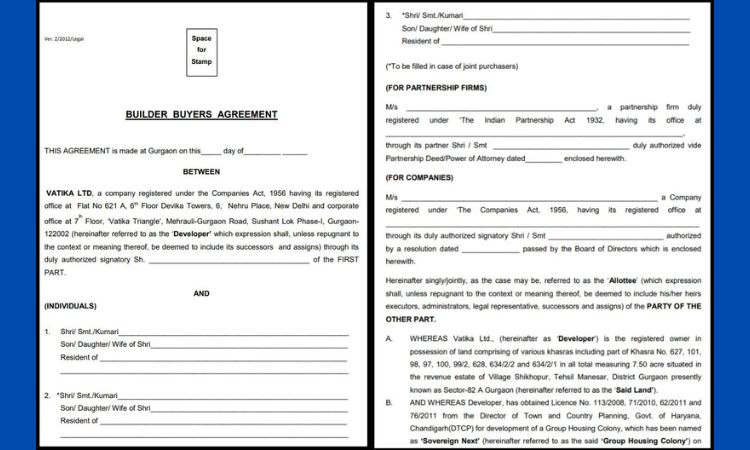
Builder Buyer Agreement (BBA) Format
There is no particular or fixed format of a BBA, but here is a standard format of a Builder Buyer Agreement. This agreement contains every detail of the project, the builder, and the amenities.
Difference Between Builder Buyer Agreement and Sale Deed
Here is a key difference between Builder Buyer Agreement (BBA) and Sale Deed that every home buyer or investor should know:
| Builder-Buyer Agreement | Sale Deed |
| Signed at the time of booking or purchase. | Executed after full payment and readying of the property. |
| Contains terms & conditions of sale and delivery. | Contains details of sale, transfer of ownership, and delivery of possession. |
| BBA does not transfer ownership | It legally transfers ownership from the builder to the buyer. |
Legal Framework and RERA’s Role
Before RERA, most BBAs were one-sided, heavily favoring builders. Buyers had a very little legal protections, and clauses such as price escalation, changes in the area, and unreasonable service charges were often imposed unfairly.
With RERA:
- Builders must submit a prescribed proforma BBA at the time of project registration.
- BBAs must stick to RERA provisions, promoting transparency and fairness.
- Only upto 10% can be taken as advance/booking amount before the agreement is formally registered.
- If the project is delayed, builders may have to pay compensation/penalties to the buyers.
These changes have strengthened buyer protection and made the BBA a vital document in real estate transactions.
Steps involved in Drafting & Finalising a BBA
1. Initial Drafting: Builders usually prepare an initial draft based on RERA guidelines, including key highlights.
2. Buyer Review: Buyers should read the whole agreement carefully. It’s advisable to get a builder-buyer agreement PDF format for detailed review and comparison and so that you can also save it digitally.
3. Legal Consultation: It is advised to seek a property lawyer to avoid unfair clauses or legal edits, and do the process smoothly.
4. Negotiation: Before signing, Buyers can negotiate terms: such as roles and responsibilities, penalties, and possession expected timelines.
5. Registration: After mutual agreement from both parties agree, the BBA is signed and formally registered legally for enforceability.
Key Clauses you Must review thoroughly
Understanding key clauses helps the individual to avoid unexpected issues:
- Possession & Delay Penalties: You need to make sure the agreement clearly states the possession date and compensation payable if the builder delays delivery.
- Payment Terms: Then you must verify exact payment milestones aligned with construction progress.
- Cancellation Policy: Be aware of your exit rights and the method for calculating any refunds.
- Mechanism for Resolving Dispute: In case of any disputes you must check for arbitration, mediation, or legal procedures specified within the BBA.
Practical Tips Before You Sign a Builder Buyer Agreement (BBA)
Here are some essential tips you should follow before signing a BBA:
- Verify RERA registration of the project.
- Cross-check all approvals and certifications (OC/CC, NOCs).
- Make sure all commitments made in brochures or presentations are recorded in the agreement.
- Take your time and carefully read each clause before signing.
- You must request for clarification or charges if any terms seem unclear or not fair to you.
Conclusion
In conclusion, a Builder-Buyer Agreement (BBA) is an important document between you and the builder. It is among the most important document a homebuyer or an investor must know.
A BBA offers legal protection by clarifying the terms, payment schedules, deliverables, and timelines, ensuring accountability for both the builder and the buyer.
After the implementation of RERA Act, these agreements have become more structured and transparent, making it easier for buyers to invest confidently in real estate.
You should always read, analyse, and understand your Builder-Buyer Agreement (BBA). Also, you should check all the tips mentioned above before signing, and consider legal consultation to protect your best interests.
Thankyou to read this article completely, if you find this helpful please share it others. For more such informative content, follow us on our social media handles.
FAQs
1. Is a BBA legally binding?
Yes, a Builder-Buyer Agreement is a legally binding contract enforceable in court and under RERA.
2. What happens if the builder delays possession?
As per RERA, if a builder fails to give possession on time, then they have to pay penalties.
3. Can the terms of a BBA be changed after signing?
No, terms cannot be changed unilaterally; both parties must agree to any amendment.
4. Is registration of BBA mandatory?
Yes, in many states under RERA, registration of BBA is compulsory to make it enforceable.
5. What is the difference between a BBA and a Sale Deed?
A BBA is just an agreement that explains the deal between you and the builder. On the other hand, a Sale Deed is the final document that actually makes you the legal owner of the property.