
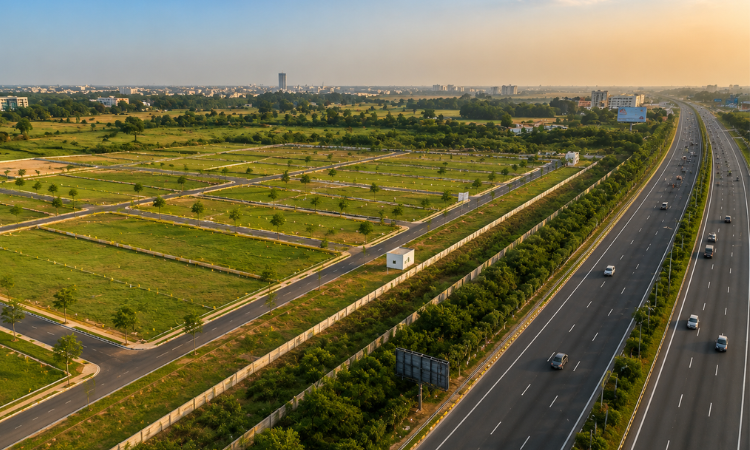

If you have ever sat in bumper-to-bumper traffic crawling from Delhi toward the Himalayan foothills, you know the frustration. What should be a scenic drive to Dehradun often stretches to six or seven grueling hours. That era is now officially over.
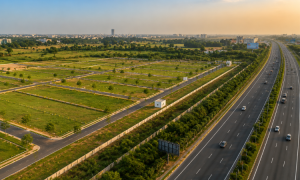
The Delhi Dehradun Expressway is officially known as the Delhi-Saharanpur-Dehradun Economic Corridor. It is a 210-kilometre access-controlled, six-lane highway developed by the National Highways Authority of India (NHAI) under the Bharatmala Pariyojana.
It connects Akshardham Temple in Delhi directly to Dehradun, the winter capital of Uttarakhand, cutting travel time to just 2 to 2.5 hours.
In this detailed blog, we will know more about the Delhi Dehradun Expressway, its Route Map, Toll, Opening Date, Cost and more. So, let us start this blog.
Delhi Dehradun Expressway Quick Overview
| Detail | Information |
| Total Length | 210 km (approximately 213 km including approach stretches) |
| Start Point | Akshardham Temple, East Delhi |
| End Point | Dehradun, Uttarakhand |
| States Covered | Delhi, Uttar Pradesh, Uttarakhand |
| Number of Lanes | 6 lanes (expandable to 8 lanes) |
| Design Speed | 100 km/h minimum |
| Project Cost | Approximately Rs. 11,868 to Rs. 13,000 crore |
| Entry/Exit Points | 16 across the full corridor |
| Underpasses | 113+ (VUP, LVUP, SVUP types) |
| Railway Overbridges | 5 |
| Major Bridges | 4 |
| Bus Shelters | 62 |
| Service Roads | 76 km running parallel to the expressway |
| Elevated Road Sections | Approximately 29 km |
| Developed By | NHAI under Bharatmala Pariyojana (EPC model) |
| Foundation Stone | February 26, 2021 by Nitin Gadkari |
| Opening | April 14, 2026 by PM Narendra Modi |
Also Read – Ganga Expressway
Delhi Dehradun Expressway Route Map and Key Cities Covered
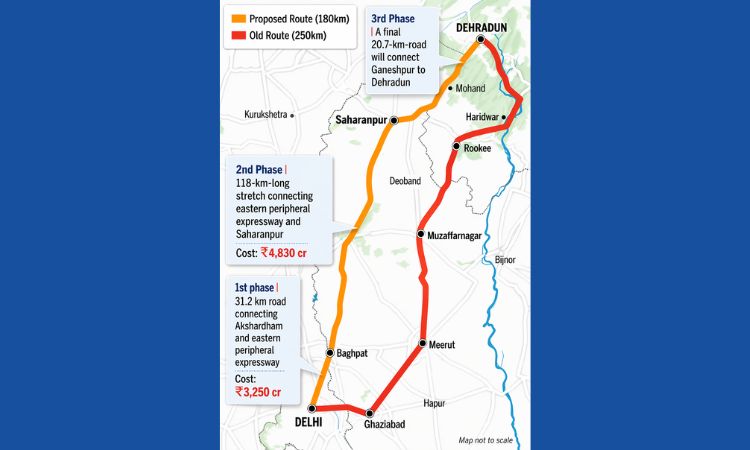
The expressway follows a north-to-northwest trajectory through some of India’s most economically active territories before climbing into the Shivalik foothills.
The starting point is Akshardham, Delhi, and the end point is ISBT Dehradun. Delhi Dehradun expressway route will pass through Loni, Baghpat, Baraut, Shamli, Saharanpur and Ganeshpur.
Cities and Districts on the Main Route
| City / District | State |
| Akshardham (Start) | Delhi |
| Baghpat (EPE Interchange) | Uttar Pradesh |
| Baraut | Uttar Pradesh |
| Shamli | Uttar Pradesh |
| Muzaffarnagar (outskirts) | Uttar Pradesh |
| Saharanpur | Uttar Pradesh |
| Ganeshpur | Uttar Pradesh / Uttarakhand border |
| Dehradun (End) | Uttarakhand |
Spur Expressways
| Spur Name | Details |
| Saharanpur–Roorkee–Haridwar Expressway | 50.7 km, six-lane. Connects the main corridor to Haridwar and the Char Dham highway network (Kedarnath, Badrinath, Gangotri, Yamunotri). |
| Ambala–Shamli Expressway | 121 km, six-lane. Branches off near Shamli toward Ambala, Haryana. Further connects to the Bareilly–Gorakhpur Expressway and Siliguri–Gorakhpur corridor. |
Delhi Dehradun Expressway Construction Phases
This expressway is built in four phases. Each phase is designed around the terrain, traffic needs, and land availability for that stretch.
| Phase | Route | Length / Lanes | Key Features |
| Phase 1 | Delhi (Akshardham) to Baghpat (EPE) | 32 km / 12 lanes | Includes 6.4 km aerial corridor from Geeta Colony to Khajoori Khas within Delhi. First section opened to public in December 2025. Travel time Delhi to Baghpat reduced from 1 hour to 25-30 minutes. |
| Phase 2 | Baghpat (EPE) to Saharanpur Bypass | 118 km / 6 lanes | Longest greenfield section. Passes through western UP agricultural zone. Features 7 interchanges and approximately 60 underpasses for local traffic and livestock movement. |
| Phase 3 | Saharanpur Bypass to Ganeshpur | 40 km / 6 lanes | Upgrades existing road infrastructure. Acts as the transition zone between the UP plains and the Shivalik foothills before entering forested terrain. |
| Phase 4 | Ganeshpur to Dehradun | 20.7 km / 6 lanes | Passes through Shivalik Forest Division, Rajaji Tiger Reserve, and Dehradun Forest Division. Includes the 12 km elevated wildlife corridor, 340-metre Daat Kali Tunnel, and twin elevated sections for wildlife safety. |
Delhi Dehradun Expressway Key Features
Infrastructure Features
| Feature | Details |
| Travel Time Saved | Reduced from 5-6 hours to 2 to 2.5 hours between Delhi and Dehradun |
| Design Speed | Minimum 100 km/h throughout most of the corridor |
| Traffic Management | Advanced Traffic Management System (ATMS) installed across full length |
| Tolling System | Closed tolling — GPS-based, pay only for distance traveled (no toll booths) |
| FASTag | Next-Gen FASTag 3.0 with satellite-based GPS tracking |
| Service Roads | 76 km of parallel service roads for local and city traffic |
| Elevated Sections | Approximately 29 km of elevated road through urban and sensitive zones |
| Vehicular Underpasses | 113+ underpasses (VUP, LVUP, SVUP) |
| Railway Overbridges | 5 railway overbridges |
| Bus Shelters | 62 bus shelters along the corridor |
| Daat Kali Tunnel | 340 to 370-metre tunnel near Dehradun reducing road footprint through forested terrain |
| Capacity | Expected to carry 20,000 to 30,000 vehicles per day |
Asia’s Longest Wildlife Corridor
One of the unique features of this expressway is its Asia’s longest elevated wildlife corridor. Rather than cutting through one of India’s most biodiverse forest regions, the engineers built the road over it.
The result is Asia’s longest elevated wildlife corridor, 12 kilometres long, that passes over Rajaji National Park and Rajaji Tiger Reserve. It is designed to protect animals while ensuring high-speed connectivity.
Wildlife Corridor Details
| Feature | Details |
| Corridor Length | 12 km elevated section over Rajaji National Park and Rajaji Tiger Reserve |
| Total Eco-Sensitive Stretch | 20 km passing through Shivalik Forest Division, Rajaji Tiger Reserve, and Dehradun Forest Division |
| Animal Underpasses | 6 dedicated animal underpasses |
| Animal Passes | 8 animal passes for smaller mammals |
| Elephant Underpasses | 2 dedicated underpasses, each 200 metres long |
| Animal Underpass Length | 10.97 km total underpass length for wildlife movement |
| Sound Barriers | Installed along sensitive stretches in collaboration with Wildlife Institute of India (WII) |
| Light Barriers | Installed to minimise impact of artificial light on nocturnal animals |
| Habitat Species | Tigers, elephants, greater hornbills, king cobras, leopards |
| Study Conducted | Joint NHAI and WII study titled Landscapes Reconnected along 18 km stretch |
| Species Documented | 18 wildlife species recorded using underpasses including elephants, golden jackal, nilgai, sambar, spotted deer, and Indian hare |
| Elephant Usage | 60+ documented instances of elephants safely using the underpasses |
| Comparable Project | Only the second highway in India with a dedicated wildlife corridor after NH-44 |
Note: The project required diversion of forest land and felling of thousands of trees during construction, estimated at nearly 19,000 trees. Compensatory afforestation has been undertaken by the government, though environmental groups continue to call for stronger long-term ecological monitoring.
Delhi Dehradun Expressway Opening Date and Project Timeline
Prime Minister Narendra Modi officially inaugurated the Delhi Dehradun Expressway on April 14, 2026, on the occasion of the Baisakhi festival.
He also visited Saharanpur to review the wildlife corridor and performed a pooja at the Jai Maa Daat Kali Temple near Dehradun. So, Delhi Dehradun Expressway has been officially opened on April 14 2026.
| Date | Milestone |
| February 26, 2021 | Foundation stone laid by Union Minister Nitin Gadkari |
| December 4, 2021 | PM Narendra Modi formally re-lays foundation stone; full-scale construction begins |
| Mid-2025 | Phase 1 (Akshardham to Baghpat, 32 km) construction completed |
| December 2025 | Akshardham to Baghpat stretch (18 km) officially opened for daily commuters |
| Early 2026 | Packages 3 and 4 partially opened; final signage and lane marking work underway |
| April 14, 2026 | Full expressway inaugurated by PM Narendra Modi |
Delhi Dehradun Expressway Toll Charges and FASTag Details
The Delhi Dehradun Expressway uses one of the most modern tolling systems currently deployed on any Indian highway a distance-based closed tolling model with no physical toll booths.
| Aspect | Details |
| Tolling Model | Closed tolling system, users pay only for the exact distance traveled on the expressway |
| Technology Used | Next-Gen FASTag 3.0 with satellite-based GPS tracking |
| Toll Booths | No fixed toll booths deductions happen automatically via linked FASTag account |
| Recommended FASTag Balance | Rs. 3,000 minimum recommended for users planning full Delhi to Dehradun route |
| Toll Collection Start | Began after official inauguration on April 14, 2026 |
| Advantage | No stopping at toll plazas; faster throughput and reduced traffic congestion |
Delhi Dehradun Expressway Real Estate Impact
Every major expressway India has built has reshaped property markets along its route. The Delhi Dehradun Expressway is already doing the same.
The Dehradun Delhi Expressway will be a game-changer for real estate growth across Delhi, Uttar Pradesh, and Uttarakhand. This corridor will unlock massive opportunities for both homebuyers and investors due to rapid connectivity.
Real estate experts from Colliers India, InvestoXpert Advisors, Square Yards, and Propertypistol have all flagged strong appreciation potential across the 210 km corridor over the next 18 to 24 months.
Expected Price Appreciation by Micro-Market
| Location / Micro-Market | Expected Appreciation | Primary Demand Type |
| Narela, Bawana (Delhi) | 15 to 25% | Plots, affordable residential |
| Tronica City, Loni (Ghaziabad) | 15 to 25% | Affordable plots, connectivity-driven demand |
| Baghpat, Baraut | 20 to 30% | Residential, plotted developments |
| Shamli, Muzaffarnagar outskirts | 10 to 20% | Industrial, warehousing |
| Saharanpur, Chhutmalpur | 15 to 20% | Industrial clusters, logistics hubs |
| Doiwala, Mohand (Dehradun fringe) | 15 to 25% | Farmhouses, homestays, second homes |
| Dehradun City, Rajpur Road | 20 to 25% | Villas, retirement communities, second homes |
| Rishikesh, Haridwar | 15 to 20% | Hospitality, wellness retreats |
Source: Colliers India, InvestoXpert Advisors, Square Yards, and Propertypistol analysts, April 2026.
Expert Comments
| Expert | Comment |
| Vimal Nadar, Colliers India | The expressway connects Ghaziabad, Noida, Greater Noida, and Meerut to Muzaffarnagar, Saharanpur, and Dehradun. Anticipates 1 to 2 million sq. ft. of Grade A industrial supply in Delhi-NCR micro-markets, with annual leasing potentially reaching 1 to 1.5 million sq. ft. |
| Vishal Raheja, InvestoXpert Advisors | Areas such as Loni, Narela, Bawana, Tronica City, Yamuna Vihar, Karawal Nagar, and East Delhi expect a 15 to 25% price uplift over the next 18 to 24 months. |
| Anupam Rastogi, Square Yards | Dehradun will witness a surge in second-home demand, plotted developments, and villa communities. Property prices expected to appreciate 15 to 25% in key stretches. |
Conclusion
The Delhi Dehradun Expressway is more than just a faster road. It is a genuine reimagining of how North India connects, from the capital’s eastern fringes to the shadow of the Himalayas.
The 2.5-hour journey time makes weekend trips to Rishikesh feel casual. It brings Haridwar’s ghats within easy reach of a Delhi morning. It gives Dehradun’s real estate market a powerful boost that experts say will sustain for years.
And with Asia’s longest wildlife corridor running through its spine, it shows that ambitious infrastructure need not come entirely at the cost of the natural world.
Whether you are a traveler, a real estate investor, a pilgrim heading to Char Dham, or simply someone who wants to understand India’s infrastructure story in 2026, the Delhi Dehradun Expressway is one of the most important developments to follow.
FAQs
1. Will FASTag Annual Pass work on Delhi-Dehradun Expressway?
Yes, FASTag Annual Pass will work on Delhi-Dehradun Expressway.
2. What is the total length of the expressway?
The total length of the Delhi-Dehradun Expressway is 210km. It runs from Akshardham in East Delhi to Dehradun in Uttarakhand.
3. What is the construction cost?
The construction cost of the Dehradun Delhi expressway is approximately Rs. 11,868 crore to Rs. 13,000 crores under the Bharatmala Pariyojana.
4. Which states does it pass through?
It will pass through Delhi, Uttar Pradesh (Baghpat, Baraut, Shamli, Muzaffarnagar, Saharanpur), and Uttarakhand.
5. Is the Dehradun Delhi expressway open?
Yes, the Delhi–Dehradun Expressway is fully open. The expressway is now fully operational. Prime Minister Narendra Modi formally inaugurated it on April 14, 2026.
6. Does it connect to Haridwar?
Yes. A 50.7-km spur connects to Haridwar, which links to the Char Dham highway network for Rishikesh, Kedarnath, Badrinath, Gangotri, and Yamunotri.
7. How many lanes does it have?
The Delhi-Dehradun Expressway is designed as a 6-lane access-controlled expressway, with future expansion capability.