


India is on the verge of a major travel revolution. The central government has given the green light to seven new bullet train corridors that will connect some of the biggest cities in India.
These high-speed rail lines will cut travel times dramatically — what used to take hours will now take just minutes.
Railway Minister Ashwini Vaishnaw announced these new routes, saying that Prime Minister Narendra Modi has approved all seven corridors. These routes were announced as part of the Union Budget 2026-27, where a record amount of money has been set aside for railway development.
What is a Bullet Train?
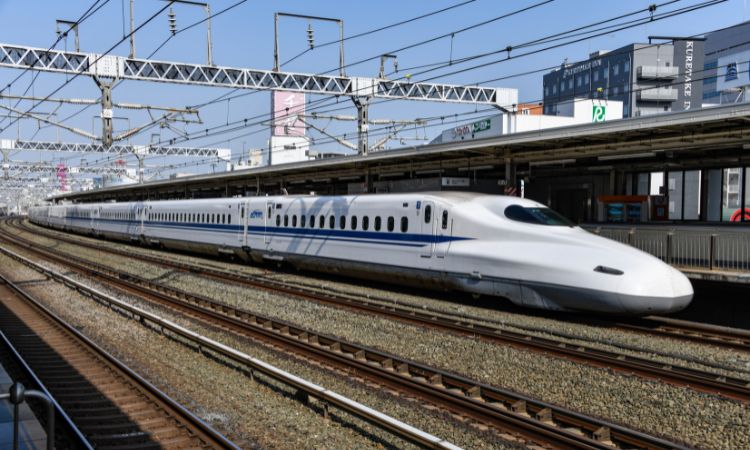
A bullet train is also known as a high-speed train, and it travels much faster than regular trains. These trains can go up to 320 kilometres per hour (kmph). This is more than three times faster than most trains running in India today. Bullet trains use special tracks built only for high-speed travel, which makes them safer and smoother.
India already has one bullet train project under construction from Mumbai to Ahmedabad, and this corridor was started in 2017 with help from Japan using their famous Shinkansen (bullet train) technology. Now, the government wants to build seven more such lines.
Complete List of 7 New Bullet Train Corridors in India
Here is a look at all the new bullet train routes and how fast they will be:
| Route | Distance | Current Time | Bullet Train Time |
| Mumbai To Pune | 150 km | 3 hrs | 48 minutes |
| Mumbai To Ahmedabad | 508 km | 6+ hrs | 1 hr 57 mins |
| Bengaluru To Chennai | 350 km | 5-6 hrs | 73 minutes |
| Bengaluru To Hyderabad | 618 km | 8 hrs | 2 hrs 10 mins |
| Pune To Hyderabad | 560 km | 7+ hrs | 2 hrs 8 mins |
| Delhi To Varanasi | 813 km | 8+ hrs | 3 hrs 15 mins |
| Varanasi To Siliguri | 800 km | 15+ hrs | ~6 hours |
| Delhi To Lucknow | 490 km | 6 hrs | 2 hours |
Together, these corridors cover nearly 4,000 kilometres across India and are expected to attract investments of around Rs 16 lakh crore, according to government sources.
South India Gets a Big Boost
In these 7 new bullet train corridors, three routes are in South India. This is a big deal because South India’s major cities like Bengaluru, Chennai, and Hyderabad are important technology and business centres.
Right now, travelling between these cities by train takes 5 to 8 hours. After the completion of the bullet train, the same journeys will take just 73 minutes to 2 hours.
The Bengaluru-Chennai route will be especially important. It will be Southern India’s first high-speed rail corridor, and it will connect two of the country’s biggest IT hubs. Travellers, business people, and students who regularly move between these cities will save a huge amount of time.
Mumbai-Pune: A Game Changer for Western India
The Mumbai-Pune bullet train route is one of the most exciting announcements. Right now, the journey between these two cities takes about 3 hours by train. With the bullet train, the same distance will be covered in just 48 minutes.
Railway Minister Vaishnaw said that once these projects are complete, cities like Mumbai, Pune, Ahmedabad, Surat, and Hyderabad could become part of one big connected economic region. This means businesses, workers, and students could easily move between these cities every day, just like a short commute.
North India and the East Get Faster Connections
In northern India, the Delhi-Varanasi corridor will cut travel time to about 3 hours and 15 minutes. Today, the same journey takes over 8 hours. The Delhi-Lucknow route will take just 2 hours on the bullet train.
The Varanasi-Siliguri corridor will connect the eastern parts of India, improving connectivity for states like Bihar, Jharkhand, and West Bengal. This route will help reduce travel times that currently stretch to 15 hours or more.
When Will the First Bullet Train Run?
India’s first bullet train is expected to make its first run on a 100-kilometre stretch between Surat and Vapi in August 2027. This is part of the Mumbai-Ahmedabad corridor, which is currently under construction. The full 508-kilometre Mumbai-Ahmedabad line is expected to be ready by 2029.
The seven new corridors announced recently are at different stages. The National High-Speed Rail Corporation Limited (NHSRCL), the government body responsible for building bullet trains, has already submitted detailed project reports (DPRs) for six of the seven new corridors to the Railway Ministry. The Varanasi-Siliguri DPR is still being prepared.
Cost of 7 New Bullet Train Corridors
Bullet trains are very expensive to build because they need special tracks, bridges, tunnels, and stations. The Mumbai-Ahmedabad project alone has already cost over Rs 85,000 crore, and the total estimated cost has risen to nearly Rs 1.98 lakh crore due to land acquisition delays and other costs.
The seven new corridors together are expected to require investments of approximately Rs 16 lakh crore. The Union Budget 2026-27 has set aside a record Rs 2,78,000 crore for Indian Railways, overall the highest ever, showing the government’s serious commitment to upgrading India’s rail network.
Why Does India Need Bullet Trains?
India is a large country with over 1.4 billion people. Every day, millions of people travel between cities for work, education, and personal reasons. As the population grows and cities expand, the pressure on roads, airports, and regular trains keeps increasing.
Bullet trains can help in many ways. They are faster than cars and regular trains. They are more environmentally friendly than aeroplanes. They reduce traffic on highways. They create new jobs during construction and operation. And they help develop smaller towns and cities along the route.
When people can travel between two cities in under an hour, it changes how they live and work. A person could live in Pune and work in Mumbai without spending hours commuting. A business owner in Chennai could attend a meeting in Bengaluru and come back the same day.
What Experts Are Saying
Transport experts and economists have generally welcomed these announcements. Faster rail connectivity between major cities can boost trade, tourism, and economic growth. It can also reduce India’s dependence on short-distance flights, which are more polluting.
However, some experts have also pointed out challenges. Building bullet train lines requires massive land acquisition, which can be difficult and time-consuming in India.
Environmental clearances and community consultations can also delay projects. The Mumbai-Ahmedabad corridor itself has faced such challenges, with costs nearly doubling from original estimates.
Conclusion
India’s bullet train ambition is part of a much bigger plan to modernise its rail network. Alongside high-speed trains, the government is also expanding the Vande Bharat semi-high-speed train network, upgrading stations, electrifying rail lines, and building new metro systems in cities.
If the seven new bullet train corridors are successfully built and operated, India will join a small group of countries with extensive high-speed rail networks including Japan, China, France, Germany, and Spain.
The coming years will be crucial. As construction begins on more sections of the Mumbai-Ahmedabad line and detailed planning starts for the new corridors, India’s bullet train dream is slowly turning into reality.
Key Facts at a Glance
- India announced 7 new bullet train corridors in Union Budget 2026-27
- Bullet trains will travel at speeds of up to 320 kmph
- Mumbai to Pune will take just 48 minutes (currently ~3 hours by train)
- Bengaluru to Chennai will take 73 minutes (currently 5-6 hours)
- The 7 corridors span nearly 4,000 km and require ~Rs 16 lakh crore investment
- India’s first bullet train ride is expected between Surat and Vapi in August 2027
- NHSRCL has submitted DPRs for 6 of the 7 new corridors to the Railway Ministry
- Record Rs 2,78,000 crore budget allocated to Indian Railways in 2026-27