


Mumbai is one of the most crowded and biggest cities in India. Every day, millions of people travel by road, local train, and bus.
The traffic is often terrible, and commute times can go up to two or three hours. For many years, people in Mumbai have been waiting for a better way to travel.
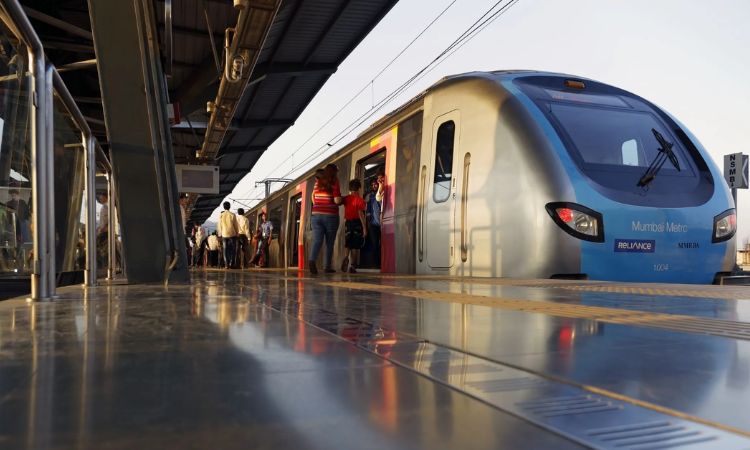
That wait is now over. Mumbai Metro Line 3, also called the Aqua Line, is fully open. It is one of the biggest infrastructure projects in Mumbai and India. Aqua Line is Mumbai’s first completely underground metro line.
In this detailed article we will know everything about Mumbai Metro Line: its route map, how much it costs, how to use it, and what it means for people living and investing in Mumbai. So, let us start this blog.
Mumbai Metro Line 3 (Aqua Line) Overview
| Detail | Information |
| Official Name | Mumbai Metro Line 3 (Aqua Line) |
| Total Length | 33.5 km |
| Total Stations | 27 (26 underground, 1 at-grade) |
| Corridor | Aarey JVLR (North) to Cuffe Parade (South) |
| Fully Operational Since | October 8, 2025 |
| Fare Range | ₹10 to ₹80 depending on distance |
| First Train | 5:55 AM from both ends |
| Last Train | 10:30 PM |
| End-to-End Travel Time | About 54 minutes |
| Operated By | Delhi Metro Rail Corporation (DMRC) |
| Built By | Mumbai Metro Rail Corporation Limited (MMRC) |
| Daily Ridership (Oct 2025) | Around 1.5 lakh passengers |
| Project Cost | Around ₹33,000–38,000 crore |
| Train Type | Alstom Metropolis (6-car trains) |
| Signalling System | CBTC (Communication-Based Train Control) |
What Is Mumbai Metro Line 3 or Aqua Line?
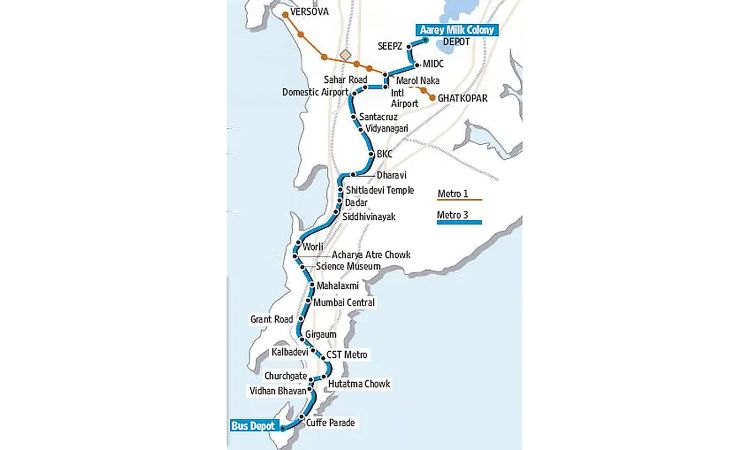
Mumbai Metro Line 3 is also known as the Aqua Line. It is a rapid transit line that runs underground across Mumbai. The Aqua Line route connects Aarey Colony in the northern suburbs to Cuffe Parade in South Mumbai.
This route passes through most important areas of Mumbai, like the international airport, BKC (Bandra Kurla Complex), Worli, Dadar, CSMT, Churchgate, and many more. This single metro line touches almost every major business and residential hub in Mumbai.
Before this metro, there was no direct, fast, and affordable option to travel from the northern suburbs to South Mumbai. People had to either take the overcrowded local train or sit in heavy traffic for hours. The Aqua Line has changed all that.
Mumbai Metro Line 3 is operated by the Delhi Metro Rail Corporation (DMRC) under a 10-year operations contract. It was built by the Mumbai Metro Rail Corporation Limited (MMRC), a joint venture between the Government of India and the Government of Maharashtra on a 50:50 basis.
Mumbai Metro Line 3 (Aqua Line) Route Map
Aqua Line History and Background
The idea for a north-south underground metro in Mumbai had been talked about for many years. The Aqua Line, or Mumbai Metro Line 3, was officially approved by India’s central government on June 28, 2013. The planned route was the Colaba–Bandra–SEEPZ corridor.
The construction work started via Aarey Colony to Cuffe Parade in 2017. It was one of the most technically difficult metro projects in India. The line had to be built underground through Mumbai’s dense urban areas, below old buildings, existing rail lines, and busy roads.
Phase-Wise Opening of Mumbai Metro Line 3 (Aqua Line)
| Phase | Stretch | Distance | Inauguration Date |
| Phase 1 | Aarey JVLR to BKC | 12.69 km | October 5, 2024 |
| Phase 2A | BKC to Acharya Atre Chowk (Worli) | 9.31 km | May 9, 2025 |
| Phase 3 (Final) | Acharya Atre Chowk to Cuffe Parade | 10.99 km (approx) | October 8, 2025 |
Phase 1 was inaugurated by Prime Minister Narendra Modi on October 5, 2024, and commercial operations started on October 7, 2024.
Phase 2A was inaugurated on May 9, 2025, by Chief Minister Devendra Fadnavis. The final phase was also inaugurated by Prime Minister Modi on October 8, 2025, and now this route is completely open. It is a 33.5 km long route that passes through the most important areas of Mumbai.
Mumbai Metro Line 3 (Aqua Line) Station List
The Aqua Line Metro Route has a total of 27 stations, out of which 26 are underground, and 1 (Aarey JVLR) is at grade (at ground level). Here is the full list from north to south:
| No. | Station Name | Nearby Area / Landmark | Phase |
| 1 | Aarey JVLR | Aarey Colony, Goregaon | 1 |
| 2 | SEEPZ | SEEPZ Industrial Zone, Andheri East | 1 |
| 3 | MIDC | MIDC Andheri Industrial Area | 1 |
| 4 | Marol Naka | Marol, Andheri East | 1 |
| 5 | Sahar Road | Near Airport Area | 1 |
| 6 | CSIA Terminal T2 | Chhatrapati Shivaji Int’l Airport T2 | 1 |
| 7 | Santacruz Metro | Santacruz East | 1 |
| 8 | Bandra Colony | Bandra East | 1 |
| 9 | Bandra Kurla Complex (BKC) | BKC – Mumbai’s Financial Hub | 1 |
| 10 | Dharavi | Dharavi | 2A |
| 11 | Shitala Devi Mandir | Shitaldevi Temple area | 2A |
| 12 | Dadar | Dadar (W) – interchange with local trains | 2A |
| 13 | Siddhivinayak | Siddhivinayak Temple, Prabhadevi | 2A |
| 14 | Worli | Worli, near BPT colony | 2A |
| 15 | Acharya Atre Chowk | Worli Naka, Lower Parel | 2A |
| 16 | Nehru Science Centre | Worli, Nehru Science Centre | 3 |
| 17 | Mahalaxmi | Mahalaxmi Racecourse area | 3 |
| 18 | Mumbai Central (JSS) | Mumbai Central Railway Station | 3 |
| 19 | Grant Road | Grant Road East | 3 |
| 20 | Girgaon | Girgaon, South Mumbai | 3 |
| 21 | Kalbadevi | Kalbadevi Market area | 3 |
| 22 | CSMT Metro | Near Chhatrapati Shivaji Maharaj Terminus | 3 |
| 23 | Hutatma Chowk | Flora Fountain, Fort | 3 |
| 24 | Churchgate | Churchgate Station, Marine Lines | 3 |
| 25 | Vidhan Bhavan | Maharashtra Vidhan Sabha, Nariman Point | 3 |
| 26 | Cuffe Parade | Southern tip of Mumbai | 3 |
| 27 | *(Depot Station)* Aarey JVLR | Aarey Depot (maintenance) | – |
Note: The Aarey JVLR station also serves as the main maintenance depot (car shed) for the Aqua Line trains.
Mumbai Metro Line 3 Fare Chart
The fare on Mumbai Metro Line 3, or Aqua Line, is based on the distance you travel. Here is the fare structure:
| Distance | Fare (Single Journey) | Notes |
| 0 – 3 km | ₹10 | Minimum fare |
| 3 – 12 km | ₹20 | |
| 12 – 18 km | ₹30 | |
| 18 – 24 km | ₹40 | |
| 24 – 30 km | ₹50 | |
| 30 km and above | ₹60 to ₹80 | Maximum fare |
These are among the most affordable fares for an air-conditioned rapid transit service in Mumbai. The full journey from Aarey JVLR to Cuffe Parade costs around ₹60–80, compared to spending ₹200–400 on a cab for the same route during peak hours.
Mumbai Metro Line 3 – Train Timings and Frequency
Aqua Line runs every day of the week, including Sundays and public holidays. Here are the timings of Mumbai Metro Line 3.
| Detail | Aarey JVLR End | Cuffe Parade End |
| First Train | 5:55 AM | 5:55 AM |
| Last Train | 10:30 PM | 10:30 PM |
| Train Frequency (Peak Hours) | Every 5 minutes | Every 5 minutes |
| Train Frequency (Off-Peak) | Every 7–10 minutes | Every 7–10 minutes |
| End-to-End Journey Time | ~54 minutes | ~54 minutes |
The metro runs very frequently during morning and evening rush hours. This means you rarely have to wait long for a train.
Also Read – TOP 10 Posh Areas in Mumbai
How to Use Mumbai Metro Line 3 – Tickets and Smart Cards
- Token (Single Journey Ticket) – You can buy a single-journey token from the ticket vending machines or token counters at any station. The token is a small chip-based card that you tap at the entry gate, travel with, and then insert at the exit gate.
- NCMC Card (National Common Mobility Card) – The easiest way to travel on Mumbai Metro Line 3 is using the NCMC (National Common Mobility Card). This is a RuPay contactless smart card launched on June 10, 2025, by Chief Minister Devendra Fadnavis in partnership with MMRC, NPCI, and State Bank of India. With the NCMC card, you just tap and travel. No need to buy a new token every time. The same card works on Metro Lines 1, 2A, and 7 and also on BEST buses. You can buy this card at any Metro Line 3 station or at SBI branches. It is one of the best and most convenient ways to travel.
- Mumbai One App – MMRC also has the Mumbai One mobile app for ticket booking and travel planning. However, note that there is no mobile connectivity underground right now. So, it is best to buy your ticket or top up your NCMC card before entering the station.
Important Note: As of now, there is no mobile phone signal inside the underground tunnels. This means you cannot use UPI or phone-based payment apps while inside. MMRC has acknowledged this issue and is in talks with telecom operators to fix it. In the meantime, use cash, a token, or your NCMC card for travel.
Key Stations on Mumbai Metro Line 3 (Aqua Line)
- Aarey JVLR (Northern Terminus) – This is the starting point of the Aqua Line. It is located in Goregaon and is the only above-ground (at-grade) station on the entire line. The car shed and maintenance depot for all Aqua Line trains is located here. Future plans include connecting this station to Pink Line 6.
- CSIA Terminal T2 (Airport Station) – This is the airport metro station for Chhatrapati Shivaji Maharaj International Airport. It is connected directly to Terminal 2 through a 100-metre Foot Over Bridge (FOB). This makes it very easy for air passengers to take the metro directly to and from the airport. This is a huge convenience for travellers who want to avoid Mumbai’s notorious airport traffic.
- BKC (Bandra Kurla Complex) – It is one of the biggest financial and business districts of Mumbai. There are hundreds of companies, banks, and embassies based here. It is one of the busiest metro stations on the Aqua Line. It is also an interchange point with the upcoming Yellow Line 2B.
- Dadar – Dadar is one of Mumbai’s most important transit hubs. It connects to both the Central and Western Railway suburban trains. The Dadar metro station on Line 3 creates a major interchange, making it much easier to switch between the metro and local trains. This is a big relief for daily commuters.
- Siddhivinayak – This station is located very close to the famous Siddhivinayak Temple in Prabhadevi. Thousands of devotees visit the temple every week, and now they can reach it easily by metro.
- Churchgate – It is one of South Mumbai’s most important train termini for the Western Railway. The Aqua Line’s Churchgate station creates a metro-to-railway interchange, offering commuters a faster way to reach South Mumbai.
- CSMT Metro – This station is near the iconic Chhatrapati Shivaji Maharaj Terminus, also known as Victoria Terminus (VT). It connects the Aqua Line with Central Railway’s main hub, making travel even more seamless across the city.
- Cuffe Parade (Southern Terminus) – Cuffe Parade is the southernmost point of the Aqua Line. It is located at the tip of Mumbai’s peninsula. Future plans include extending the line further towards Navy Nagar by about 2.5 km, which will improve connectivity to the far south of Mumbai.
Technical Details – The Engineering Behind the Aqua Line
Building Mumbai Metro Line 3 was an enormous challenge. Here is a quick look at the technical details of the Aqua Line route:
| Technical Feature | Details |
| Track Gauge | 1,435 mm (Standard Gauge) |
| Electrification | 25 kV, 50 Hz AC Overhead Line |
| Signalling System | CBTC (Communication-Based Train Control) |
| Rolling Stock | Alstom Metropolis trains |
| Number of Coaches | 6 coaches per train |
| Train Capacity (per train) | Approx. 2,500 passengers |
| Number of Tracks | 2 (one in each direction) |
| Depth (max underground) | Approx. 30–35 metres below ground |
| TBM (Tunnel Boring Machines) | 17 TBMs were used for tunnelling |
| No. of Tunnel Contracts | 5 main underground contracts (UGC) |
The CBTC signalling system allows trains to run at very short intervals safely. The Alstom Metropolis trains used on this line are modern, air-conditioned, and designed for high-capacity urban transit. Each train can carry about 2,500 passengers, and trains can run as frequently as every 3–4 minutes when needed.
Mumbai Metro Line 3 (Aqua Line) Funding
Aqua is one of the most expensive infrastructure projects in Mumbai, India. The total cost of this project is estimated at around ₹33,000 to ₹38,000 crore. Here is how it was funded:
- The Government of India and the Government of Maharashtra together built MMRC as a 50:50 joint venture.
- Japan International Cooperation Agency (JICA) provided a majority of the funding — about 57.2% — through an Official Development Assistance (ODA) loan of ₹13,235 crore.
- The JICA loan comes with very favourable terms: a 30-year repayment period, a 1.15% interest rate for project operations, and a 0.01% interest rate for consulting services.
- The rest of the funds came from equity contributions from the central and state governments.
The Japan International Cooperation Agency (JICA) is one of the biggest supporters of this massive project, and they are also involved in various high-speed rail infrastructure projects of India.
Their long-term, low-interest loans have made it possible to build world-class projects like Mumbai Metro Line 3 (Aqua Line).
How Mumbai Metro Line 3 Is Changing Daily Life?
- Reducing Commute Time – It reduces the travelling time between Aarey Colony and Cuffe Parade. Before the Aqua Line, a road trip from Aarey Colony to Cuffe Parade during peak hours could take anywhere from 90 to 100 minutes. By metro, the same journey takes about 54 minutes, almost half the time. For people who travel this route every day, that saves nearly 1 hour daily, or around 20–25 hours per month.
- Reducing Traffic Congestion – The Aqua Line is expected to take around 6.5 lakh vehicles off Mumbai’s roads every day once it reaches full capacity. A 35% reduction in traffic congestion on the BKC-Aarey corridor has already been reported. This not only helps metro users but also benefits everyone on the road.
- Airport Connectivity – The direct link from CSIA Terminal T2 to the metro station has been a game changer for airport travellers. Earlier, reaching the airport from South Mumbai or Andheri during rush hour could take over an hour by road. Now, passengers can take the metro and reach Terminal T2 comfortably, without worrying about traffic.
- Better for the Environment – Fewer cars on the road means less pollution and less fuel use. It is estimated that the Aqua Line will lead to ₹3.54 lakh in daily fuel savings across the city. Over time, this translates into significant environmental and financial benefits for Mumbai.
- Connecting Employment Hubs – Mumbai Metro Line 3 directly connects the biggest employment zones in the city: SEEPZ, Marol Naka, MIDC, BKC, Worli, Fort, Nariman Point, and Cuffe Parade. Now, workers can now commute between these areas faster, comfortably, and at very low cost. This is great news for both employees and businesses.
What is the Impact of Mumbai Metro Line 3 on Real Estate?
This infrastructure project has a major impact on property prices across Mumbai. Here is what you need to know:
1. Overall Price Appreciation
Properties within 500 metres of Aqua Line stations have seen 10–15% price appreciation since metro operations began. In some areas closer to BKC and Worli, the appreciation is even higher, ranging from 12–18% for residential properties.
2. Area-Wise Property Trends
| Area / Station | Approx. Property Rate (2025–2026) | Key Impact |
| BKC | ₹35,000–₹60,000 per sq ft (residential) | Commercial office rents up from ₹250 to ₹700 per sq ft |
| Worli | ₹45,000–₹85,000 per sq ft | Strong demand from HNI buyers and investors |
| Mahalaxmi | ₹61,800 per sq ft | Surge due to metro + infrastructure growth |
| Santacruz | ₹43,898 per sq ft (avg) | Rising demand near airport metro |
| Dadar / Prabhadevi | ₹30,000–₹50,000 per sq ft | Strong demand due to dual metro + rail connectivity |
| Cuffe Parade | ₹1.40–₹1.60 lakh per sq ft | Premium South Mumbai; metro adds prestige value |
| Parel / Lower Parel | ₹40,000–₹50,000 per sq ft (projected 2026) | 10–15% jump expected post full operations |
3. Rental Yields
Rental yields near Metro Line 3 stations have improved to 2.8–3.5% per year in commercial-adjacent areas like BKC and Worli. This is higher than the Mumbai city average of 2.2–2.8%. Studio and 1 BHK apartments near key metro stations are seeing the highest demand and the fastest rental absorption.
4. Transit-Oriented Development (TOD)
The government and private developers are now focusing on Transit-Oriented Development, or TOD, it means mixed-use residential and commercial projects will be built within 500–800 metres of metro stations.
These projects command a premium price because they offer convenience, connectivity, and high resale value. If you are looking to invest or buy property in Mumbai, then you should consider properties in TOD zones near the Aqua Line. It will give you better returns and appreciation.
5. For Investors
Investors who bought properties near proposed metro stations 3–4 years ago have already seen 30–40% appreciation in some cases.
While those early gains are now priced in, the fundamentals remain strong. The upcoming extension of the Aqua Line from Cuffe Parade towards Navy Nagar could trigger another 5–8% uplift in newly served areas once officially announced. As a property investor, it will be a game-changing opportunity.
Mumbai Metro Line 3 (Aqua Line) Challenges and Issues Faced
- Environmental Controversies – The construction of the Aarey car shed was one of the most controversial decisions of this entire project. Aarey Colony is a green zone in Mumbai. Activists and environmentalists filed several public interest litigations (PILs) opposing the cutting of trees for the metro depot. There were large protests, especially in 2019, when trees were cut overnight. The issue went all the way to the Supreme Court of India. Eventually, the car shed was built at Aarey JVLR, but the environmental debate highlighted the importance of balancing infrastructure development with green space preservation.
- Delays and Cost Overruns – This project faced significant delays like most large infrastructure projects in India. The original deadline was pushed back multiple times. Earlier it was expected this project would start operations by 2021 but eventually opened Phase 1 only in October 2024. The total cost also rose significantly from the original estimate. Many factors contributed to this—soil conditions, underground utilities, COVID-19 disruption, and the technical difficulty of tunneling in a dense urban environment.
- No Mobile Connectivity Underground – When Phase 1 opened in October 2024, one of the most common complaints from commuters was the complete lack of mobile phone signal inside the tunnels and underground stations. This makes UPI payments, app-based ticketing, and phone calls impossible while underground. MMRC has said it is working with telecom operators to install network equipment, and Wi-Fi is also planned at key stations. For now, commuters are advised to use the NCMC card or buy tokens in advance.
- Change Management at Ticket Counters – Some passengers reported that ticket counters ran out of change for cash transactions in the early weeks of operations. MMRC has since taken steps to address this, but it was a minor operational challenge in the beginning.
Mumbai Metro Line 3 and Its Connections to Other Transport
One of the biggest strengths of Mumbai Metro Line 3 is how well it connects to other modes of transport:
| Station | Connection | Type |
| CSIA Terminal T2 | Chhatrapati Shivaji Int’l Airport T2 | Direct via Foot Over Bridge |
| Sahar Road | Near Airport T1 (domestic) | Short road connection |
| Dadar | Central Railway + Western Railway | Suburban local train interchange |
| CSMT Metro | Central Railway + Harbour Line | Suburban local train interchange |
| Churchgate | Western Railway | Suburban local train interchange |
| Mumbai Central (JSS) | Western Railway long-distance trains | Railway station connection |
| BKC | Yellow Line 2B (upcoming) | Future metro interchange |
| Aarey JVLR | Pink Line 6 (upcoming) | Future metro interchange |
| All Stations | BEST Bus services | NCMC card accepted |
When future lines like Yellow Line 2B and Pink Line 6 are completed and connected, the Aqua Line will become an even more powerful transit backbone for the city.
Future Plans for the Mumbai Metro Line 3 (Aqua Line)
- Extension to Navy Nagar – MMRC is planning to extend the Aqua Line further south from Cuffe Parade to Navy Nagar by about 2.5 km. This will improve metro access to the far south of Mumbai and reduce the gap between the metro network and the Navy area. No official opening date has been announced yet, but this extension is expected to provide another boost to property prices in the southern tip of Mumbai.
- Ridership Growth Target – When the full line opened in October 2025, daily ridership was around 1.5 lakh (150,000). Once the line reaches full potential, it is expected to serve 13 lakh (1.3 million) passengers every day. By 2055, that number could go up to 31.5 lakh (3.15 million) daily passengers—making it one of the busiest metro lines in India.
- Mobile Connectivity and Wi-Fi – MMRC has confirmed plans to introduce mobile phone connectivity and Wi-Fi at key underground stations. Once this is done, UPI payments and app-based ticketing will work seamlessly, making the commute even more convenient.
- Integration with MMR Transit – The long-term vision is to integrate the Aqua Line with all other metro lines, suburban railways, and bus services in Mumbai under a single ticketing system. The NCMC card is the first step in this direction. In the future, one card or one app should be enough to travel anywhere in Mumbai.
Useful Tips for Commuters
- If you travel regularly, you should buy an NCMC card; it saves time and works across multiple transport modes.
- Buy your token or top up your card before going underground, since there is no mobile signal inside.
- Arrive at least 10–15 minutes early during peak hours, as stations can be busy.
- Use the metro’s airport station at CSIA Terminal T2 to avoid traffic when catching flights.
- If connecting to local trains, use Dadar, CSMT, Churchgate, or Mumbai Central stations on Line 3.
- To visit the Siddhivinayak Temple, take the metro to the Siddhivinayak station—it’s the most convenient option.
- Keep some cash or small change handy for the initial months as the payment ecosystem is still developing.
- All stations are fully accessible for persons with disabilities, with lifts and tactile paths.
Conclusion
Mumbai Metro Line 3 or Aqua Line, is much more than just a metro line. It is a transformational project that is reshaping the way Mumbai moves.
For the first time, there is a fast, affordable, air-conditioned, and fully underground connection from the northern suburbs all the way to the southern tip of the city.
For daily commuters, it means less time in traffic and more time for family and work. For businesses, it means better access to talent and customers.
For property investors, it means rising values and strong rental demand. For the city as a whole, it means less pollution, less congestion, and a more modern urban future.
The Mumbai Metro Line 3 or Aqua Line has already crossed 1 crore total riders and is growing steadily every month. With planned extensions, improved connectivity, and future metro line integrations, Mumbai Metro Line 3 is set to become the spine of Mumbai’s public transport system for decades to come.
Frequently Asked Questions
Q1. What is the full form of MMRC?
Ans. MMRC stands for Mumbai Metro Rail Corporation Limited.
Q2. Is Mumbai Metro Line 3 fully operational?
Yes. The entire 33.5 km line from Aarey JVLR to Cuffe Parade became fully operational on October 8, 2025, after being completed in three phases.
Q3. How long does it take to travel the full length of the Aqua Line?
The end-to-end journey from Aarey JVLR to Cuffe Parade takes about 54 minutes.
Q4. Can I use UPI or Google Pay at Mumbai Metro Line 3 stations?
UPI and digital payment apps do not work inside the underground stations because there is no mobile signal. You can use them above ground at ticket counters before entering. NCMC card is the recommended payment option for now.
Q5. Does the Aqua Line go to Mumbai Airport?
Yes. The CSIA Terminal T2 station on Aqua Line is directly connected to Mumbai Airport’s Terminal 2 via a Foot Over Bridge. You can reach the airport by metro without any road travel.
Q6. Will Mumbai Metro Line 3 increase property prices?
Yes, property prices near Line 3 stations have already risen by 10–15% in most areas, with some locations near BKC and Worli seeing even higher appreciation. The trend is expected to continue.
Q7. Is Mumbai Metro Line 3 safe during monsoon season?
Since the line is mostly underground, it is largely protected from the effects of Mumbai’s heavy monsoon. Unlike elevated metro lines or surface roads, the Aqua Line is designed to operate without weather-related disruptions.
Q8. How do I reach Siddhivinayak Temple by Aqua Line?
You can take the Aqua Line and get off at Siddhivinayak station. The temple is within easy walking distance from the station exit.