News Elementor

Latest Posts

top reasons to buy or invest in rohini

Why Rohini Is a Smart Choice for Homebuyers & Investors? 

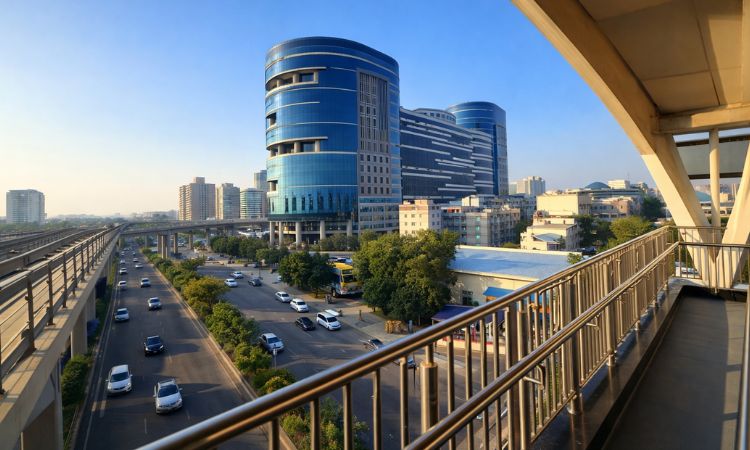
Rohini was the first sub-city project built by the Delhi Development Authority (DDA) in the 1980’s, and has a long history of being a thriving residential community for people of all income ranges. Rohini, located in North Delhi, has more than 50 sectors, excellent social infrastructure and connectivity.  So, what makes this area of North Delhi a great place to buy a home or invest?   The old historic feel of North Delhi can be felt when you visit any part of North Delhi, including Rohini in North-West Delhi. Like many other parts of North Delhi, Rohini has all the services necessary for everyday living, including schools and hospitals, as well as quick access to many of the major commercial areas in the region.   There are all types of homes in this area, such as builder floors or apartments. This article looks into the investment potential of this region by examining the areas within Rohini that represent the best sector for an investment; the current market values for property within the area and what has been the increase in price since initial construction of the building.   Rohini, located on the outskirts of Delhi, is a popular community in which to live that has both independent floors and apartments throughout the community. It is easy to find commercial activity or popular places to go when you are near Rohini, such as Pitampura or Mangol Puri, Badli Village, Mukarba Chowk, Shahbaad, Daulatpur or Bawana, Also the Delhi Technological University [DTU]. Best Sector to Live in Rohini, Delhi With more than 50 well-planned sectors complete with parks, community halls, and retail shops, Rohini’s sectors can provide a variety of living options for its residents. The largest of these is Sector 3 and the smallest sits within the second sector; therefore for those looking at mid-income family homes in Rohini, both 11 & 24 are the ideal sectors. For those with investment in mind there are also Sector 9, 13 and 14 may be ideal for purchasing apartments or flats in Delhi. If you’re looking to purchase a property ready to occupy then Sector 16 would also have properties available.  Few Popular Sectors to live in Rohini, Delhi are:   Sectors 1-10 These sectors are surrounded by Budh Vihar, Mongol Puri, Shalimar Bagh, Pitampura, Rithala, etc., which means they have good connectivity to the rest of Delhi through the use of Outer Ring Road or the Bhagwan Mahavir Marg, as well as through the use of the Mongolpuri Flyover.  Sectors 11-20 These sectors have good access via NH 9, NH 44, and Kadambari Road.  Sectors 21-30 These areas are well connected by both roadways as well as the Metro; key stretches of roads in these locations include: Western Yamuna Canal Link Road; Dr. KN Katju Marg; NH-44. Sectors 31-40 These localities include the Rohini Heliport and have access to key roadways getting into/out of these sectors, including Kanjiwaha Road; Jat Ram Marg; Bawana Road.  Sector 41 This sector is within close proximity to Inder Enclave, Agar Nagar, and Pratap Vihar  What are the top Factors Influencing Housing Demand in Rohini, Delhi? Rohini is a very desirable and thriving place to invest for a number of reasons. You can summaries the main reasons for this investment in Rohini into five categories:  Relatively Affordable Property Prices  The majority of the residential units in Rohini consist of DDA housing in the forms of Lower Income Group (LIG) and Middle-Income Group (MIG) housing categories. The average price for property in the Rohini area at this time is approximately: There is a great deal of price variation in property throughout the Rohini area based on the zoning and sector in which you purchase properties. The table below shows the prices for various properties currently for sale in some of the best sectors in Rohini:  Rohini sectors  Price per sq. ft.  Sector 8  Rs 15,800  Sector 9  Rs 16,650  Sector 13  Rs 15,200  Sector 14  Rs 18,000  Sector 18  Rs 11,750  Sector 23  Rs 8,950  Sector 24  Rs 8,850  Sector 28  Rs 7,800  Sector 35  Rs 13,200  Reliable Rental Income  A consistent rental income is another reason to think about entering the real estate market in Rohini. For example, the maximum rental price for a 2BHK builder floor would be approximately Rs 40,000 per month. On average, 2BHK apartments in Rohini could rent for between Rs 35,000 to Rs 38,000 per month.  Similarly, the maximum rental for a 3BHK apartment or flat would be approximately Rs 65,000 per month while the maximum rental, on average, for a 3BHK builder floor would be Rs 55,000 to Rs 75,000 per month. If you find yourself renting in areas that are close to the Rithala Metro Station, Maharaja Surajmal Stadium and the main road, you will likely be faced with higher rental prices. Examples of these sectors include: 14, 19, 20 and 21.  Well-connected with micro-market  Rohini is situated in the heart of North Delhi. It is a well-developed location and close to all essential like schools, metro, hospital, malls etc. It offers seamless connectivity to major parts of Delhi and NCR.   Rohini is well-connected to metro stations like Rohini East, Rohini West, Rithala Metro Station. These stations are situated along the Red Line of the Delhi Metro.   This location is well-connected via Outer Ring Road, Ring Road, NH-44 (GT Karnal Road) and Rohtak Road. You can quickly reach IGI Airport, ISBT Kashmere Gate and other important locations of Delhi.   You will also enjoy seamless daily commuting to work in Noida, Gurgaon and in Delhi’s office sectors because both NH-9 and NH-44 are quickly accessible from the area. The distance from New Delhi railway station is approximately 20 km, while the nearest railway station to Rohini (Shakur Basti) is approximately 9 km away.  Strong Social Infrastructure  Rohini has excellent social infrastructure, and there are numerous well-known academic institutions within a radius of 6 km of the locality. Among the educational institutions are; the Bhagwan Parshuram Institute of Technology, the Delhi Institute of Advanced Studies, the Delhi Technological University and the Fire Safety Management Academy. There are also many Healthcare institutions close to Rohini. For example, Dr. B.R. Ambedkar Hospital, Shubham Hospital and Springdales Hospital are located between 4 km and 8 km from Rohini. Below is an overview of some of the key facilities available in Rohini:   Commercial hubs  Netaji Subhash Place, Bawana Industrial Area, Narela Industrial Estate  Accessibility  New Delhi Railway Station at 19.5 km, Served by three dedicated metro stations on Red Line- Rohini East, Rohini West and Rithala, Old Delhi/Delhi Railway Station at 19 km, Azadpur Bus Terminal at 12.5 km, IGI Airport at 29 km   Schools & colleges  Delhi Technological University, Mount Abu Public School, Jindal International School and...
Read more
Lucknow Kanpur Expressway

Lucknow Kanpur Expressway – Status, Opening Date, Map, Update & More

After the Purvanchal and Ganga Expressway, Uttar Pradesh gets its next expressway, and that is the Lucknow Kanpur Expressway. You can also call it “Awadh Expressway.” It is a major new infrastructure project in Uttar Pradesh designed to reduce travel time between Lucknow and Kanpur. It is a 6-lane access-controlled expressway that will cut travel time and boost regional connectivity and economic growth. The length of this expressway is 63km. The approved budget for the construction of this expressway is Rs. 4,700 crores. According to NHAI, construction of the Awadh expressway began in January 2022. The project is expected to enhance regional economic growth, strengthen urban–industrial links, and significantly improve the overall travel experience between Lucknow and Kanpur. In this article, we will explore Lucknow Kanpur Expressway, its Status, Opening Date, Key Features, Economic aspects, and more. So, let us start this blog. Lucknow Kanpur Expressway Overview Feature Data Total Cost ₹4,700 crore Length Approximately 63 km Total Lanes 6-lane highway Reduced Travel Time 35-45 minutes (current time: 3 hrs) Current Status 80% complete Expected to open (new opening date) (Earlier was May-June 2025); now it is expected to open in March 2026 Next-gen Technology Used AIMC (Automated & Intelligent Machines) Starting at Shaheed Path, Lucknow Connecting Lucknow Ring Road, Agra-Lucknow Expressway Ending Point Nawabganj, Kanpur Lucknow-Kanpur Expressway Opening date This expressway project is anticipated to be open for public use during March 2026. Lucknow Kanpur Expressway – Travel Time & Project Cost The Lucknow-Kanpur Expressway Project will be built along a 63 km corridor and will provide a time savings of approximately 30 minutes compared to the existing driving times of 1.5 to 3 hours. It will also have a cost of approximately Rs 4700 crore, and the corridor will be configured as a modern access-controlled route that will eliminate traffic congestion, enhance roadway safety, and reduce fuel consumption. This budget is issued for the entire project, including Bridges, underpasses and flyovers The Kanpur-Lucknow Expressway, which is to connect to the Ganga Expressway, will complement the significant reduction in distance and time needed to travel from East to West and Vice-Versa in UP. Lucknow-Kanpur Expressway Route Map This expressway consists of 62.76 Kms (39 miles) connecting: Starting Point: Shaheed Path in South Lucknow Ending Point: Azad Chauraha near Kanpur’s Ganga Bridge The expressway traveling parallel to NH-27 and will reduce the time between the two cities by approximately 50 minutes compared to the current 2-hour trip. Also Read – Delhi Mumbai Expressway Lucknow-Kanpur Expressway: Current Progress Currently, approximately 80% of the construction is completed with work progressing rapidly using AMG technology, according to NHAI personnel using 3D automatic machine-guided (AMG) technology. The Lucknow-Kanpur Greenfield Expressway, which will utilize the latest technology and improve connectivity and high-speed travel for commuters and businesses, is anticipated to transform travel between the two cities, reducing travel times to 40-50 minutes. This ₹4700 crore investment will prove to be a game changer for businesses and commuters in Uttar Pradesh. Kanpur Lucknow Expressway: Economic Impact This expressway will have a tremendous impact on the economy of the region and will likely benefit farmers, students, businesses, and industries by improving their ability to reach markets, access educational institutions, and receive healthcare as well as find employment opportunities; thereby, supporting the development of the UP economy as it will serve as a catalyst for improving these areas. The expressway will make it easier for people to travel to educational institutions of all types in the vicinity of Lucknow and Kanpur. It will facilitate movement of students from rural areas to urban universities and other educational facilities as well as create new opportunities for economic growth and development at the local community level. Therefore, this road project will serve as the catalyst for substantial change between these two great centres of Learning in Uttar Pradesh. Future Ready Infrastructure As per the National Highways Authority of India (NHAI), the development of the new Lucknow – Kanpur Expressway represents a major breakthrough in the field of infrastructure development in India because it has successfully addressed many of the challenges associated with building complex infrastructure. In addition, the new expressway has been constructed with the application of a variety of cutting-edge engineering technologies including: The construction of multiple vehicular and pedestrian underpasses, box culverts, reinforced soil (RS) walls, and well-planned interchanges intended to facilitate the safe and efficient movement of traffic through the system, as well as to provide access points for pedestrians along with an adequate stormwater management system. Lucknow-Kanpur Expressway Key Features The National Highway Authority of India (NHAI) has pioneered the use of Automated & Intelligent Machines (AMIC) for the first time in India. These machines are equipped with the following capabilities: Conclusion Overall, the Lucknow-Kanpur Expressway will be a game-changer project for Uttar Pradesh. It will offer faster, safer, and smoother connectivity between these two cities. This expressway will encourage industrial and real estate growth along the corridor and reduce travel time and traffic congestion. It will strengthen economic activity and improve daily commuting. FAQs
Read more
Jewar Airport Noida

Jewar Airport Noida – Location, Opening Date, Status & More

Jewar international airport- officially known as The Noida International Airport, Jewar, is set to be one of the most advanced and largest aviation hubs in India. Planned to ease footfall at the IGI Airport, Delhi, and to make Noida-Greater Noida-Yamuna Expressway a global economic hub, this new airport is already making news, attracting investors, and defining future travel for millions. The project is one of the most ambitious infrastructural developments in India, which has ultra-modern terminals besides smooth multimedia connectivity. This blog will cover it all such as the Jewar Airport Noida Location Map, the current status of construction, date of opening, distance to major cities and the current updates. Jewar Airport Noida Overview Aspects Details Official name of Jewar International Airport Noida International Airport Location of Jewar Airport Jewar, Gautam Buddha Nagar District, Uttar Pradesh, India Date of commencement of construction of Jewar Airport June 2022 Date of Opening of Jewar Airport (Phase I) August 2026 (expected) Jewar Airport Code by IATA DXN Authority Noida International Airport Limited (NIAL) Powered by Yamuna International Airport Pvt. Ltd. (YIAPL) Type of Airport Public Status of construction Under-construction Jewar Airport Cost Rs. 29,650 crores Jewar Airport Area 1334 hectares (3296.386 Acres) Total Terminals 4 Terminal Total no. of Runways 6 Runway Runway length 4 km Jewar Airport official Website www.niairport.in Noida International Airport Actual Images Latest Update on Jewar Airport Noida The Jewar International Airport, located in Noida, India, aims to provide excellent service to Delhi NCR’s growing population. However, residents near the airport are still waiting for confirmation on its opening date as it continues missing open dates. Earlier this month, Union Minister of Civil Aviation Ram Mohan Naidu announced that the Jewar International Airport will open in February; however, official sources from the airport headquarters indicate some major parts of the development are not complete. Therefore, it is likely it will not open anytime soon. The estimated total cost of the Jewar International Airport’s first phase is approximately Rs 6,800 crores (approximately $1 billion), with the first official opening date estimated for September 2024. The airport spokesperson has stated that there has been no cost increase on the project; however, there have been approximately 17 months of construction delay. Recent reports indicated that construction was moving rapidly within the architecturally cohesive landscape at the Jewar International Airport and foundations will soon be laid for multiple sections of the airport. These reports and sources also revealed that the Jewar International Airport does not anticipate opening by the projected March date, as there are many construction activities remaining before the airport can actually begin operations. “I don’t think they will be able to open even in March 2026”, a source on the Jewar International Airport said, as there is still too much pending construction. Explore Premium Residential Projects Near Jewar International Airport Projects Location ATS Pristine Sector-150, Noida Experion Elements Sector-45, Noida Godrej Woods Sector-43, Noida M3M Jacob and Co Sector-97, Noida M3M Cullinan Sector-94, Noida What Makes Noida International Airport Special? 1. One of India’s Largest Airports in the Making Once completed, Jewar International Airport Noida is expected to handle 70 million passengers annually in its final phase. The airport will feature: Strategic Location: Crafted for effortless Connectivity The Jewar Airport Noida Location Map clearly shows why this spot was chosen — perfect for travellers from: Noida to Jewar Airport Distance About 40–45 km, making it easily reachable via: Jewar Airport Construction Status: Where Things Stand Today The construction is moving forward rapidly with: As per the latest updates on Jewar International Airport Latest News, the first phase is almost done, reflecting strong progress. Jewar Airport Noida Opening Date The expected opening date for Jewar International Airport is Mid 2026, allowing both domestic and international flights to begin operations. Once open, this airport is set to become NCR’s biggest aviation asset. World-Class Features & Future-Ready Infrastructure Noida International Airport promises: Noida International Airport – Economic Impact Jewar Airport Noida is expected to: The area surrounding the airport is already experiencing a boom, led by significant investments and new industrial corridors. Jewar International Airport Latest News Conclusion Jewar International Airport is not just an aviation project – it is also a publicity of the rising global potential of India. With world-class design, powerful connectivity, and a massive economic impact, the airport is set to rewrite NCR’s future and transform the entire region into a global business hub. FAQs
Read more
top 10 Posh Areas in Bangalore

Top 10 Posh Areas in Bangalore in 2026: Most Expensive Areas

Bangalore, frequently referred to as Silicon Valley of India, was established to be one of the most technologically advanced cities as well as having desirable residential areas suitable for a number of living and investment preferences. The city consists of many premium areas, such as the leafy traditional-style neighbourhoods and the modern tech-oriented suburbs that provide stylish living, strong infrastructure, superior education, and high value real estate. In addition to these two categories there are many more types of posh areas in Bangalore. Each of these residential locations provides residents with the convenience of having access to basic necessities while offering the ultimate way to enjoy an upscale lifestyle through high-end amenities, excessive green space and the highest security and exclusivity. This article provides a complete overview of the richest residential localities in Bangalore with the following information; Industry Trends, Investment Insights, Price Trends, Key Amenities and Future Growth. List of Posh in Bangalore in 2026 S.no. Posh Areas of Bangalore 1. Koramangala 2. Indiranagar 3. Jayanagar 4. Whitefield 5. Sadashivanagar 6. Rajajinagar 7. HSR Layout 8. Malleshwaram 9. Lavelle Road 10. Richmond Town 1. Koramangala – Among Posh Areas in Bangalore Pincode – 560034 It is one of the best places to live in Bangalore, thanks to the combination of numerous offices, restaurants and recreational areas. Koramangala is comprised of premium residential enclaves, well-developed start-up industries, co-working spaces, a wide selection of dining options and entertainment venues.  With increasing numbers of offices, restaurants and entertainment venues, Koramangala has the perfect balance between residential comfort and commercial activity. It is one of the best neighbourhoods for people who want to live a busy urban lifestyle because of the options available. Koramangala also has a high level of social activity and provides residents with many opportunities to meet new people and experience an exceptionally diverse mix of cultures. Trends in properties in Koramangala: High prices relative to other areas, high rental demand, excellent lifestyle quality so it is highly attractive for reselling and/or appreciation. Property prices: Rs. 19,828 per sq. ft. 2. Indiranagar Pincode – 560038 Indiranagar stands firm at the 2nd rank in the list of top 10 posh areas in Bangalore. It offers a cosmopolitan lifestyle to its residents and has a unique blend of modern-day living with traditional values. Not only are there many dining and shopping options, but you can also find homes of very high quality and design, something that is uncommon in most other neighbourhoods in Bangalore; whether you’re looking for a boutique, an upscale cafe, or luxury accommodation, all these can be found in Indiranagar. It has a busy urban community atmosphere with upscale lifestyles and is one of the fastest growing and most dynamic areas among most expensive areas in Bangalore.  Property prices: Rs. 14,150 per sq. ft.  Also Read – TOP 10 Best City to live in India 3. Jayanagar Pincode – 560011 Heritage charm meets structured planning. Broad, green avenues, parks, and community culture make it ideal for families. Real estate here is stable, premium, and less volatile. In addition to that, there is a great number of shopping centres and traditional markets located close by; the area also has a significant number of cultural amenities, such as theatres and museums, allowing people to experience both the past and present at the same time. Because of this, many families choose to live in the area due to the proximity of highly regarded schools and hospitals.  Property prices: Rs. 16,226 per sq. ft. 4. Whitefield – Among Most Expensive Areas of Bangalore Pincode – 560066 Once a quiet suburb, Whitefield is now a major residential and IT hub with high-rise apartments, gated communities, and top-tier amenities. Whitefield is located on the eastern side of Bangalore (Bangalore Urban District), via PIN code 560066; originally established as an English community and later as a multicultural community. The IT industry in Bangalore contributes primarily to the overall economic growth of Bangalore, while attracting professionals from all over India and around the world.  Property prices: ~Rs. 10,103 per sq. ft.  5. Sadashivanagar Pincode – 560080 One of the oldest elite neighbourhoods in Bangalore, featuring sprawling bungalows and tree-lined avenues. It is home to many dignitaries and long-established families. Sadashiva Nagar was originally named as “Palace Orchards” which refers to the historical royal estates of Bangalore Palace. The name was subsequently changed to Sadashiva Nagar in honouring Karnad Sadashiva Rao who was an Indian freedom fighter and philanthropist.  Sadashiva Nagar has become known as being home to a number of opulent villas and luxury residential properties owned by some of the most respected business, entertainment, government, and affluent families in Bengaluru.  Property prices: Rs. 32,073 per sq ft  6. Rajajinagar Pincode – 560010 Lush and well-connected, Rajajinagar is gaining traction with new developments and community infrastructure, blending tradition with modern living. Rajajinagar is an ideal family-oriented neighbourhood where the community has a very practical, non-flamboyant environment that promotes reliability and good access to services. The lifestyle of families in Rajajinagar has earned the area a recognition as one of the richest neighbourhoods in Bengaluru.  Property prices: ~Rs. 20000+ sq ft  7. HSR Layout Pincode -560102 A favourite among families and professionals for its planning, parks, and quiet streets. Its connectivity to IT corridors and future metro make it a smart investment. Property prices: ~Rs 15,000- 18000 Per SQ. FT. 8. Malleshwaram Pincode -560003 Well-established and leafy, Malleshwaram balances heritage with modern comforts. It is popular with families and professionals alike thanks to its location and community vibe. It is named after famous temple Kaadu Malleshwara. Malleshwara has now adopted a cosmopolitan character as one of the historically rich areas, with multi-storey apartments replacing many large bungalows. It has mixed populations, comprising large families of middle and upper-middle incomes. Retail and wholesale shops on Sampige Road, the 11th Cross Flower Market and legendry eateries on the Margosa Road has attracted all type of people.  Property prices: Rs. 15,541 per sq. ft. 9. Lavelle Road Pincode -560001 One of the most prestigious thoroughfares in the core city, known for luxury apartments, executive living, and proximity to flagship malls and CBD offices. Property here commands a...
Read more
Freehold Vs Leasehold Property

Freehold Vs Leasehold Property: Key Differences, Meaning & Ownership Rights

In India, real estate may be either freehold or leasehold. Many of you who have attended hearings about government proposals to convert certain parcels of property from leasehold to freehold may already have heard of this topic. You wonder what you should know about freehold property, how it is different from leasehold property, what benefits you would get by owning freehold property, your rights as an owner of freehold property, the documents needed to buy freehold property and a lot more. An understanding of freehold Vs leasehold property should assist you in making wise decisions about your real estate purchase/sale/investment, and is therefore helpful for both first time home buyers and experienced real estate investors. What is Freehold Property?  A freehold property means the buyer has complete ownership of both the property and the land it stands on. Once purchased, there is no limit to how long the buyer will own the land/property or for how long the property will exist (The only limitations on what the buyer can do with the property are the laws of the jurisdiction). In addition, the owner has the right to sell the property at any time or lease it to anyone. Freehold properties have clear ownership rights, making them worth more. These properties are also easier to sell and banks prefer freehold properties when giving out home loans. The homeowner (freeholder) is required to maintain the property without the involvement of anyone else. The freeholder has the right to stay in the property for as long as they own it. What is Leasehold Property? Leases indicate that you own the property for a specified period of years; however, the land itself continues to be owned by the landlord. Lease periods can last anywhere from one to ninety-nine years and then become the property of the landlord again. Generally, all sale or transfer transactions require the consent of the landlord. Leasehold properties tend to cost less than freehold properties and banks will tend to impose stricter loan terms due to a less than indefinite ownership period. If you wish to extend your lease on a leasehold property, then there may be an extra cost associated with this. Leasehold properties are usually found in areas owned by government or authority. Also Read – What is BBA in Real Estate Difference Between Freehold and Leasehold Property If you want to see the difference between freehold and leasehold properties, then you may want to check this extensive list below: Name Leasehold Freehold Time period Lease duration can be of 1, 30, 60, 99 years No tenure restrictions Ownership rights Leaseholder has the right to occupy the property for a fixed term, post which the land ownership is retained by the original owner Owner has complete ownership of the land and property indefinitely Transfer of Ownership Requires the original owner’s consent and a transfer fee may be applicable Easy to sell, transfer, or gift without restrictions Maintenance responsibility Landlord is typically responsible for the building structure, while the leaseholder may handle interiors Owner is fully responsible for maintenance and repairs Property price and value Generally lower value due to limited ownership rights and lease renewal considerations; value can depend on the remaining lease period Usually higher due to complete ownership rights Pros and Cons of Freehold Property  Pros of Freehold Property Cons of Freehold Property Pros and Cons of Leasehold Property Pros of Leasehold Property Cons of Leasehold Property What are the steps to convert a Leasehold Property to a Freehold Property? How to sell a Freehold Vs leasehold Property? Challenges & key Differences: It is important that you are knowledgeable about the process of buying a freehold or leasehold prior to purchasing a property, especially for an investor. Generally speaking, it is easier to sell freehold properties than leasehold properties because the selling process for freehold properties consists of forming a sales agreement with the buyer, and registering the deed at the sub-registrar’s office.  To sell a leasehold property, the seller must first submit the proposed sale to the governing body that owns the land under a ‘Memorandum of Transfer’ form. This is done after being granted permission from the governing body to sell, known as memorandum of transfer. The buyer and seller must also sign the memorandum, at which point the sub-registrar will validate both parties’ signatures, and 1-2 weeks later, the buyer will receive a sub-lease.  Although the sale of leasehold properties may vary slightly by removing or adding to a municipality’s by-law, you should obtain guidance from an attorney or another knowledgeable real estate professional before selling leasehold property. Generally speaking, freehold property provides you (the buyer) with complete ownership, more flexibility when selling, and more access to mortgage loans than leasehold properties, although you can typically sell leasehold property for much less than you can full ownership, as well as significantly lower maintenance costs. For this reason, it is essential that you weigh out all pros/cons of each type before making your purchase offer. Can the government take back (reclaim) freehold land? Freehold property gives you the right to full possession of the buildings and land you have purchased, which now raises the question of how the government can take back ownership of your land? Despite the kind of land you have, the government can decide to take it back if the land is in the way of developmental activities like industrialization or urbanization. You will, of course, be paid a fixed per sq. ft price based on the land. Rights of the Owners of Freehold Properties As mentioned above, one of the best benefits of freehold property is complete freedom. Below are all the possible rights that freeholders may use and take advantage of when using, occupying, utilising and/or owning their properties: FAQs
Read more
reasons to invest in Dubai Real Estate

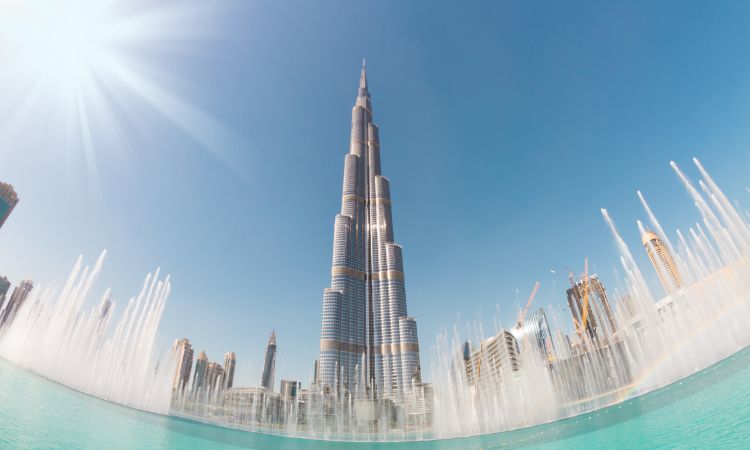
Top 10 Reasons to Invest in Dubai Real Estate in 2026

Over the past few years, Dubai has established itself as a premier destination for international real estate investors. With a combination of tax-free policies, world-class infrastructure, and robust rental yields and capital appreciation, it is no surprise that the Dubai property market is experiencing a period of sustained growth. Based on data from the first half of 2025, Dubai experienced significant growth in both the number of transactions and the total dollar value transacted, with millions of square feet sold and significant growth year over year in the dollar amounts received for transaction values. Below we present you with our Top 10 reasons why Dubai is still a leading choice for international real estate investors along with supporting factual market data and recent trends, including examples of actual returns on select properties. 1. No Property Taxes Among the multiple benefits of investing in Dubai real estate is the lack of taxation on ownership, capital gains, and rental income; therefore, investors retain 100% of their profits when selling or renting out property in Dubai and comparatively to other Western markets where taxes are extremely high on returns to investors. Why it’s important: This tax neutrality boosts net profitability and makes investment calculations far more attractive. 2. Strong Rental Yields and Cash Flow The rental yields in Dubai are among the highest globally, typically averaging between 6% and 10%, depending on where the property is located as well as the type of property. Typical average yields (2025 estimates) These returns are significantly higher than many Western cities where yields often sit between 3–5%. 3. Capital Appreciation and Market Growth Dubai’s property market has experienced a tremendous amount of price appreciation, which can be attributed to strong demand for properties from both local residents and international investors. As a result of the increasing demand for real estate, average residential property prices have risen dramatically, with most segments of the residential market experiencing an increase in average residential units by approximately 20% from 2024 to 2025, while specific segments, such as luxury and villas, have experienced even higher increases in value. Continued high demand and limited supply in the most desirable areas will continue to support the growth of asset values over the long term. 4. Global Business and Tourism Hub Dubai is centrally located between Asia, Europe, and Africa, and serves as a global hub for businesses and travel. In 2024, as a result of the growing Tourism Industry, over 17 million international visitors were welcomed into the country. Investors have tremendous opportunities to create income from short-term rentals and vacation rentals as a result of their desire to attract tourists. Dubai’s global reach means there will continue to be a strong demand for property by both residents and tourists. 5. Diverse Population and Expat Demand The demographic growth of Dubai and the influx of workers and families from around the world are creating a large expatriate population, which keeps demand for rental properties strong. Population growth in conjunction with the new residents being introduced to the housing rental market will not only create long-term demands for homes but also for rental. 6. Investor-Friendly Ownership Regulations The advantage of having investor-friendly rules and regulations regarding ownership of real estate in Dubai is the ability of foreign investors to own real estate with full freehold title in specifically specified areas. This contrasts with the majority of other global cities that would have limitations on foreign ownership. Furthermore, the ownership of real estate in Dubai has a strong legal framework and well-established systems in place to ensure proper governance and protection of real estate ownership, such as the Dubai Land Department and the Real Estate Regulatory Agency. 7. High Transaction Volume and Market Liquidity As one of the fastest-growing real estate markets in the world, Dubai’s real estate environment will provide investors with a very healthy level of liquidity to support a large volume of transactions. In just the first half of 2025 there have already been substantial increases in both volume and total value of transactions compared with 2024; therefore, it is likely that Dubai’s real estate market is trending positively. Liquidity offers investor confidence that they will always be able to enter or exit the marketplace as needed. 8. Flexible Payment and Off-Plan Options In addition to having a growing real estate market, developers in Dubai typically have post-handover payment plans as well as payment plans for off-plan purchases. These options provide investors an opportunity to invest into an asset at a lower price before completion and then pay for that space over the term of their agreement, thus maximizing returns and cash flow strategies. Additionally, off-plan investments take advantage of the low pricing of early stage investments and increase demand for real estate after the project is finished. 9. World-Class Infrastructure and Mega Projects The current and future development of Dubai’s infrastructure including expansion of metro systems, airports, new tourist attractions, etc. contributes to the strong continual demand for real estate in Dubai. New large-scale developments such as Expo City, Dubai Creek Harbour and others, will continue to attract interest, generate demand, and therefore create value for other real estate in Dubai. 10. Strong Economic Fundamentals and Stability The Dubai economy is very diverse and is resilient with several strong sectors such as trade, tourism, logistics, finance and real estate. This diversity and strength represent a stable platform for real estate investment. Additionally, Government initiatives to achieve sustainable economic development will continue to enhance investor confidence in Dubai real estate. Conclusion Overall, Dubai is among the top real estate investment destinations in 2026. This city is attracting top investors and homebuyers worldwide. The reason is its policy, tax-free ownership, strong rental yields, steady capital appreciation, and investor-friendly regulations. Dubai is one of the most efficient property markets in the world. This city is getting good benefits from population growth, rising tourism, infrastructure expansion, and a diversified economy that will ultimately increase the demand for housing. The major reason to buy or...
Read more
List of Cities in India

List of Tier 1, Tier 2, Tier 3 & Tier 4 Cities in India in 2026 – India’s City List

Indian cities have been categorised into tiers based on a mix of population size, infrastructure quality, economic development and level of urbanization as well as job market opportunity availability, levels of health services and educational attainment, level of transportation accessibility etc. This tier system helps policymakers plan urban development, allocate resources, and provides useful insights for businesses and real estate investors. Generally, Tier 1 cities are the most developed and populous urban centres, while Tier 4 cities are smaller urban locales with basic infrastructure and lower economic activity.  In this article, we will explore Tier 1 Cities in India, Tier 2, Tier 3 and Tier 4 and their real estate trends and more. So, let us start this blog. How Cities Are Classified in India? Cities in India are classified into tiers based on a mixture of population size, infrastructure quality, economic development, and urbanization levels. One commonly referenced approach, for example; Reserve Bank of India and other Indian Government departments have established various methods for doing so. A common, but not exclusive, method of categorizing urban areas in India by Tier System is based on an approximate number of people that reside in each Tier, even if the Tier System is not the only means to determine Tiers, in general Tiers are defined as follows.  Population Based Classification Classification Population Rural centre Less than 10000 Semi-urban centre 10000- 1 lakh Urban centre 1 lakh- 10 lakh Metropolitan centre Above 10 Lakh What is Tier 1 Cities in India? Tier 1 cities in India serve as major metropolitan centers providing economic activity through advanced infrastructure, access to employment opportunities, and increased cultural and educational, and commercial activity. Typical features are high concentrations of people with a strong ability to connect using airports as well as metro networks; strong access to healthcare and education resources. List of Tier 1 Cities in India Here is the list of tier 1 cities in India: S.No. Tier 1 Cities in India 1. Mumbai 2. Delhi 3. Bengaluru 4. Chennai 5. Hyderabad 6. Kolkata 7. Ahmedabad 8. Pune The tier 1 cities of India are the most important cities. They are the backbone of this country and are known for their strong economic activity, advanced infrastructure, and high standard of living. Delhi, Mumbai and Bangalore are among the top tier 1 cities in India. These cities offer top-notch education, better infrastructure, the Presence of Fortune 500 companies, and better healthcare facilities, among other things. Also, tier 1 cities have better connectivity, international airports, metro rail networks, and well-established social infrastructure. The common tier 1 cities in India are Delhi, Mumbai, Bengaluru, Chennai, Hyderabad, and Pune. These cities have high per capita income, large populations, and ample job opportunities. Key Characteristics of Tier 1 Cities A number of factors have contributed to the ranking of these cities as Tier 1 Cities of India: Real Estate Trends in Tier 1 Cities of India What is Tier 2 Cities in India? Tier 2 cities experience rapid urban growth due mainly to improvements in local economies, infrastructure, and commercial and residential real estate markets. Compared with Tier 1 metros, Tier 2 cities typically provide an advantageous combination of opportunity and cost-effective living. List of Tier 2 Cities in India 2026 S. no. Tier 2 Cities in India 1. Jaipur 2. Lucknow 3. Surat 4. Nagpur 5. Indore 6. Thiruvananthapuram 7. Bhopal 8 Coimbatore 9 Kochi 10 Patna  11 Vishakhapatnam 12 Agra 13 Ajmer 14 Kanpur 15 Mysuru 16 Srinagar The Tier 2 Cities in India are an alternative to metropolitan cities. These cities offer a lower cost of living compared to Tier 1 cities. Jaipur, Lucknow, Surat, Patna, and Nagpur are among the most common tier 2 cities in India. These cities are rapidly growing in different sectors like IT services, manufacturing, education, healthcare, and tourism. Our Government is also working to reduce the burden on Tier 1 cities by focusing on Tier 2 cities. Tier 2 cities of India, like Jaipur, Lucknow, Indore, Surat, and Kochi, have improved road networks, new airports, metro rail projects, and industrial corridors, which will make these cities more connected and business-friendly. Key Characteristics of Tier 2 Cities Real Estate Trends in Tier 2 Cities of India What is Tier 3 Cities in India? Cities that are Tier 3 contain smaller urban areas that are currently being developed. Since these cities have not yet completed development of the same size of physical infrastructure supporting either Tier 1-City or Tier 2-City, many Tier 3 Cities have seen Continued Gradual Increase in Connectivity, Job Creation, and Demand for Housing. List of Tier 3 Cities in India 2026 Here is the list of top Tier 3 Cities in India: S. no. Tier 3 Cities in India 1 Meerut 2 Bikaner 3 Udaipur 4 Salem 5 Nasik 6 Hosur 7 Etawah 8 Roorkee 9 Bhatinda 10 Hajipur 11 Rohtak 12 Jhansi 13 Madurai 14 Cuttack 15 Rajahmundry The Tier 3 cities in India are smaller and developing urban centres. These cities have lower populations but are improving their infrastructure. The economics of Tier 3 cities are mainly based on local industries, agriculture, small businesses, education, and regional trade. They play an important role in reducing the pressure on metropolitan and Tier 2 cities. Meerut, Udaipur, Roorkee, Jhansi, Bikaner, etc., are examples of top-tier 3 cities in India. These cities have shown steady improvements in road connectivity, public transport, healthcare, and educational facilities. Government initiatives, industrial corridors, and highway projects are helping develop these Tier 3 cities. Key Characteristics of Tier 3 Cities Real Estate Trends in Tier 3 Cities of India What is Tier 4 Cities in India? Tier city 4 consists of small towns and emerging urban clusters with limited or basic physical infrastructure and considerably lower levels of economic activity than that seen in Tier 1 or Tier 2 Cities. The cities in their current form act as a transition area between Rural and Urban Economies. List of Tier 4 Cities in India 2026...
Read more
Ganga Expressway

Ganga Expressway: Route Map, Status, Key Features, Completion Date & More

The Ganga Expressway project is the state’s most significant project for changing transportation, connection, economy, etc. It connects Meerut to Prayagraj (approximately 594 km), is 6 lanes wide with an access control, and will decrease the travel time nearly in half from Meerut to Prayagraj. The project will encourage the rapid expansion of industry in Uttar Pradesh and contribute to the growth of religious and geographic tourism. Also, the total investment in the project is approximately ₹36,230–40,000 crore. Therefore, the Ganga Expressway will become the first expressway that is exclusively built in one state and be one of the longest expressways ever constructed in India. In this article, we will learn about the Ganga Expressway, its Key Features, Real Estate impact, Route Map, and more. So, let us start this blog. Overview: Ganga Expressway S.no Particular Description 1. Length of Ganga Expressway 594km 2. Project Cost ₹37,350 Crore 3. Completion Date February 2026 (Expected) 4. Maintained By Uttar Pradesh Expressways Industrial Development Authority (UPEIDA) 5. Foundation 18 December 2021 6. Speed Limit 120km/hr 7. Number of Lanes 8 Lane 8. Major Cities to be Connected by Expressway Meerut, Hapur, Bulandshahr, Sambhal, Budaun, Shahjahanpur, Hardoi, Bilgram, Madhoganj, Mallawan, Bangarmau, Safipur, Unnao, Raebareli, Pratapgarh, Prayagraj What is the Ganga Expressway? The Ganga Expressway is the state’s high-speed corridor that is being constructed by the Uttar Pradesh Expressways Industrial Development Authority (UPEIDA) using the DBFOT public-private partnership (PPP). When completed, the expressway will consist of the following characteristics: Also Read – Delhi Mumbai Expressway Ganga Expressway Route This Expressway will connect National Highway (NH) 334 in Meerut to NH-2 (Prayagraj Bypass) through the centre of the Uttar Pradesh State. The alignment of the expressway was designed to accommodate for the Ganga River and will allow for the expressway to access all major districts of the state. It is a greenfield project, which means it is made from scratch, and the project cost is nearly 37,750 crores. The total length of this expressway is approximately. 596km that will pass through 12 districts. Ganga Expressway Route Map It is a major greenfield expressway of Uttar Pradesh that will connect the western UP (Meerut) to Eastern UP (Prayagraj). This will be passed through 12 major districts of Uttar Pradesh and cross various villages. It will be a game changer project that will enhance the connectivity, boost tourism and major impact on real estate. Districts covered by Ganga Expressway Ganga Expressway Village List Although UPEIDA (Uttar Pradesh Expressways Industrial Development Authority) will publish the actual village-wise list of the Ganga Expressway during the land acquisition, development and construction phases, it can be anticipated that hundreds of villages in proximity to 12 Districts will be affected by the Ganga Expressway. This expressway will passthrough 518 villages. Villages that will be near interchanges will benefit from: Note: To get the complete village list, please refer to UPEIDA district notifications and land acquisition documents. Construction and Engineering Highlights The Ganga Expressway Project consists of four packages: Ganga Expressway has significant developments like: Ganga Expressway 2026 Latest Updates Unique Feature: Emergency Airstrip There will be a 3.5-km emergency airstrip on this Expressway. It has received much media attention due to many reasons. Economic Impact of Ganga Expressway This expressway is more than just another road project. Economic Impact Tourism and Religious Importance By creating a direct route to the city of Prayag Raj, the Ganga Expressway will: Conclusion Uttar Pradesh’s infrastructure will be transformed by the Ganga Expressway, a project that has a major economic impact on the State of Uttar Pradesh through its size, modern design (including the ability to provide air transportation via an airstrip), and significant impact on how people move around. It is one of the most important projects of the UP Government that will boost connectivity, enhance trade and the economy, drive real estate demand, and boost tourism. This project is nearing completion and will reduce travel time between Meerut, Prayagraj, and other important locations. It will play an essential role in shaping the future growth of the Ganga River belt and the state as a whole. FAQs
Read more
biggest mall in India

TOP 10 Biggest Mall in India in 2026 – India’s Largest Shopping Centers

Over the past 10 years, India’s retail sector has undergone a dramatic shift from traditional retail to modernized concepts such as mega shopping centres, which offer not only places for shopping, but also dining, entertainment and an overall experience of lifestyle. In this article, we will take a closer look at the top 10 biggest mall in India, exploring the complexes that draw millions of visitors annually, regardless of whether you are an avid shopper, enjoy good food, love movies or simply want to discover more about cities and their infrastructure. In the retail world, the term “biggest” usually refers to the total gross leasable area (GLA) — the total-size of the mall allocated for tenants to rent the physical space within the shopping centre for business — where today, India’s largest shopping centres have a combined GLA of between 1.6 million and 1.1 million square feet, with over 300 different business brands, cinemas, and restaurants located within each mall. List of Top 10 Biggest Malls in India 2026 S.no. Mall Location Gross Retail area (sq. ft.) 1. Sarath City Capital Mall Hyderabad 2.7 million sq. ft. 2. Lulu international mall Lucknow 2.2 million sq. ft. 3. DLF Mall of India Noida 2 million sq. ft. 4. Phoenix Marketcity Mumbai & Pune 2+ million sq. ft. 5. Ambience Mall Gurgaon 1.8 million sq. ft. 6. Select Citywalk Mall New Delhi 1.8 million sq. ft. 7. Mantri Square Mall Bengaluru 1.5 million sq. ft. 8. Express Avenue Mall Chennai 1.5 million sq. ft. 9. Quest Mall Kolkata 1.2 million sq. ft. 10. R City Mall Mumbai 1.1 million sq. ft. 1. Sarath City Capital Mall – Hyderabad (India’s Largest Mall) At present, Sarath City Capital Mall in Hyderabad is indisputably the largest shopping mall in India by square footage; with approximately 2.8 million square feet of retail floor area, it is set to be the biggest mall in India in 2026. More than just a mall; this huge retail complex is an absolute lifestyle centre featuring shopping, dining, entertainment, social and recreational activities, special events and more, creating opportunities for community-building within the local population as well as for attracting visitors from all over the country who are looking to spend time in this vibrant retail and entertainment facility. Reasons to Visit: 2. LuLu International Shopping Mall – Lucknow & Kochi LuLu Malls have been rapidly rising in the rankings, and two of them are featured in India’s largest mall list: LuLu Mall – Lucknow As one of the most impressive retail destinations in Northern India, LuLu Mall – Lucknow represents over 2.2 million square feet of premium shopping with dining and leisure activities, and entertainment options. It is one of the largest malls in North India, where you can see top international and national brands under one roof. LuLu Mall – Kochi Lulu Mall Kochi is among the biggest shopping malls in India, where you can explore premium brands, top dining options, and multiple entertainment options. At Lulu Mall Kochi, there are 225+ national & international brands, a 9-screen multiplex cinema, and a diverse food court with Indian & international cuisines. Reasons to Visit: 3. DLF Mall of India – Noida (Largest Shopping Mall in North India) The DLF Mall of India has become a strong contender in the Indian retail market with approximately 2 million square feet of retail space and is recognized as one of the largest shopping malls not in India. Reasons to Visit: 4. Phoenix Marketcity – Mumbai & Pune Phoenix Marketcity is associated with upscale shopping experiences. The two-market presence of the malls in Mumbai and Pune are approximately 2 million square feet (example: The new Mumbai mall has about 2.1 million square feet) and rank as some of the biggest mall in India by area. Why it ranks high: The malls offer a broad brand spectrum and calendar of events as well as being located adjacent to office/hotel components within their respective larger campus. Reasons to Visit: Also Read – TOP 10 Posh Areas in Mumbai 5. Ambience Mall – Gurgaon Ambience Mall Gurgaon remains one of the most popular shopping facilities and one of the biggest malls in India, with approximately 1.8 million square feet of retail space. It is located in DLF Phase 3, Gurgaon. Ambience Mall is one of the iconic malls in Delhi-NCR, known for its huge size, luxury retail, modern design, and multiple entertainment options. In addition to providing a city vibe, the Ambience Mall offers a full range of clothing brands from high-end and high-street fashion, outdoor lounging areas and entertainment events. Reasons to Visit: 6. Select Citywalk Mall – New Delhi The next name on the list of the top 10 biggest malls in India is Select Citywalk Mall. This mall is located in Saket and is well-connected to other parts of Delhi-NCR. It is known for its open-air design, landscaped spaces, and fantastic shopping experience. This mall is spread across 1.8 million square feet, which makes it one of the largest shopping centers in India. Select Citywalk is a one-stop destination for shopping, dining, and entertainment. If you are in Delhi, it is a must-visit place. Reasons to Visit: 7. Mantri Square Mall – Bengaluru Mantri Square Mall is one of the iconic and oldest malls in Bengaluru. It is located in the heart of the city, Malleshwaram. This mall is spread across 1.5 million sq. ft area which makes it one of the biggest malls in South India. This is among the most popular malls in Bengaluru because here you can see top international and national brands with multiple dining and entertainment option. It is known for its vast retail space and excellent connectivity therefore it has high footfall. Reasons to Visit: 8. Express Avenue Mall – Chennai Express Avenue Mall is also known as EA Mall. This mall is located on Mount Road (Anna Salai), Chennai. It is one of the largest and most popular shopping malls in Chennai. In this mall, you...
Read more
top 10 Tallest Building in India

TOP 10 Tallest Building in India 2026: India’s Highest Building

The city environment of India has become completely different in the last twenty years. The Indian cities Mumbai, which is the financial capital of India, the cultural centre of Kolkata, etc. now boast some of the most unusual skyscrapers in the world. These buildings are not only architectural wonders but also epitaphs of the swift economic rise of India and the change of attitude towards life and worldly desires. By discussing the tallest building in India, we are not merely stating the presence of height but engineering perfection and high-end living at its finest. List of Tallest Building in India 2026 S. No. Building Height City 1 Lokhandwala Minerva 301 meters Worli, Mumbai 2 Palais Royale 297.5 meters Mahalaxmi, Mumbai 3 Arav Tower 290 meters Byculla, Mumbai 4 World One 280.2 meters Worli, mumbai 5 World View 277.6 meters Worli, Mumbai 6 Trump Tower Mumbai 268 meters Worli, Mumbai 7 Lodha Marquise 268 meters Worli, Mumbai 8 Nathani Heights 262 meters Mumbai Central 9 The Imperial 2 256 meters Tardeo, South Mumbai 10 The 42 260 meters Chowringhee Road, Kolkata 1. Lokhandwala Minerva – Mumbai Height: Approx. 301 metersLocation: Mahalaxmi, Mumbai Lokhandwala Minerva is a twin-tower luxury complex that is characterized by smooth design, extensive sea views, and the finest facilities. Currently, it is the tallest building in India. The tower is a mixture of modern structures and the luxury requirements of the residential market of South Mumbai and is frequently mentioned when speaking of the second tallest structure in India after Palais Royale. This project is located in Mahalaxmi that is consider as one of the posh areas in Mumbai. Lokhandwala Minerva is an iconic residential building in Mumbai that redefining luxury high-rise living in India. 2. Palais Royale – Mumbai Height: approx. 297.5 metersLocation: Mahalaxmi, Mumbai Palais Royale is regarded as the first real supertall skyscraper in India and is nowadays regarded as the tallest residential building in India. The tower is created to set new trends in the field of green luxury living, and its features include aspects such as upscale engineering, sustainable design, and high-end residential quarters that meet the needs of the high-end Mumbai population. Although the construction process was delayed, Palais Royale is still considered to be one of the most important buildings in the skyline of the city, and it is a landmark for every person who studies the largest residential building in India. 3. Arav Tower – Mumbai Height: Approx. 290 metersLocation: Mumbai Arav Tower is a high-rise residential project that is located in Byculla, Mumbai. There are 72 floors in this residential tower that offers panormoc views of the sea, it makes this one of the highest buildings in India and Mumbai. This residential project is developed by Pyramal Realty. Arav Tower offers premium residences with high-end amenities. It is located in the heart of Mumbai and close to key business districts, lifestyle hubs, and essential social infrastructure. 4. World One – Mumbai Height: Approx. 280.2 metersLocation: Lower Parel, Mumbai World One is one of the tallest residential buildings in India and Mumbai. It is developed by Lodha Group, and it redefines luxury living in India. The height of World One is approximately. 280.2 meters, and there are nearly 76 floors in this tower. It offers world-class amenities, such as luxury lounges, wellness centres, landscaped podiums, private elevators, and more. As one of the tallest buildings in India, it set a new benchmark for real estate and luxury living. 5. Lodha World View – Mumbai Height: Approx. 277.6 metersLocation: Worli, Mumbai World View is at the 5th position among the list of the top 10 tallest building in India. This project is developed by Lodha Group, and it is one of the iconic landmarks in the Mumbai City skyline. There are approximately 73 floors in this tower. It is a high-rise residential project in Mumbai. Lodha World View offers premium apartments with panoramic sea views. This building is redefining the luxury real estate in India. 6. Lodha Trump Tower – Mumbai Height: Approx. 268 metersLocation: Worli, Mumbai Trump Tower Mumbai is a brand that offers ultra-luxury living in India with its iconic golden front and international reputation. It is one of the most prestigious luxury residential addresses in Mumbai. The project boasts luxurious interiors, high-quality services, and luxurious facilities. Luxury international-grade buyers tend to identify this tower as one of the tallest residential buildings in India due to its extravagant amenities and elevation. 7. Lodha Marquise – Mumbai Height: Approx. 268 metersLocation: Worli, Mumbai Lodha Marquise is an ultra-luxury residential landmark by the Lodha Group. It is one of the highest buildings in India in 2026, adding to the charm of the Mumbai skyline. The tower is one of the Lodha World Towers complex, which embodies the best concepts of luxurious urban living, including sky lounges, high-speed elevators, and high-quality apartments. 8. Nathani Heights – Mumbai Height: Approx. 262 metersLocation: Mumbai Central The next name on the list of the top 10 highest buildings in India in 2026 is Nathani Heights. It is strategically located in Mumbai Central, stands 262m tall, and has 72 floors. This is among the tallest residential buildings in Mumbai, offering spectacular views of the Arabian Sea and the Mumbai skyline. The tower blends comfort with luxury, making it a favourite among investors and home buyers. 9. The Imperial 2 – Mumbai Height: Approx. 256 metersLocation: Tardeo, Mumbai Imperial Towers were once the tallest towers in India and are still considered among the most luxurious addresses. It is one of the most iconic luxury residential skyscrapers in Mumbai. The Imperial 2 is still ruling the skyline through its twin towers and high-quality services. It was the first of its kind to introduce high-rise luxury housing in Mumbai. 10. The 42 – Kolkata, West Bengal Height: Approx. 260 metersLocation: Chowringhee Road, Kolkata The last name on the list of the top 10 tallest buildings in India is The 42. It is an iconic residential tower in Kolkata....
Read more
1 2 3 4

Editor's Picks

Biggest Cities in India

Biggest Cities in India in 2026 – By Area, GDP & Population

India’s cityscape is incredibly diverse, vibrant, and constantly transforming. From megacities that never sleep to metropolitan regions expanding at record speed, the biggest Cities in the country carry major economic, cultural, and demographic significance. In this article, we explore what truly defines a “big” city – whether by population, land area, Population, economic strength, or overall impact. You’ll also find the Top 10 Biggest Cities in India in 2026, detailed comparisons, and a comprehensive List of major Cities in India ranked through various criteria. Biggest Cities in India by Population Here is the list of India’s largest cities by population in 2026: Rank City Population 1. Delhi 3.7 Crore 2. Mumbai 2.21 Crore 3. Kolkata 1.58 Crore 4. Bengaluru 1.44 Crore 5. Chennai 1.23 Crore 6. Hyderabad 1.13 Crore 7. Ahmedabad 90.62 Lakh 8. Surat 85.82 Lakh 9. Pune 75.26 Lakh 10. Gurgaon 13.18 Lakh Delhi is currently the most populous city/urban region in India, while Mumbai continues to be India’s most Densely populated city with an estimated 2.20 crore residents in 2025. Delhi stands out as India’s most populous urban region, driven by its role as the national capital and a major hub for governance, commerce, education, and migration. The city’s vast metropolitan spread, combined with continuous infrastructure expansion across Delhi-NCR, has contributed to its rapid population growth over the years. Mumbai, on the other hand, remains India’s most densely populated city despite having a smaller total population than Delhi. As the country’s financial capital, Mumbai attracts millions for employment in finance, entertainment, trade, and services. Limited land availability, an island geography, and high real-estate demand have resulted in extremely high population density, with millions living in compact residential areas. Among cities with comparatively lower populations in the top-10 list, Pune and Gurgaon present a different picture. Pune has grown steadily as an education and IT hub, offering a balanced lifestyle with expanding infrastructure and a relatively lower density than megacities like Delhi and Mumbai. Gurgaon, despite being one of the least populated in the list, plays a crucial role in the Delhi-NCR region as a corporate and startup hub, known for modern office spaces, planned sectors, and rapid urban development rather than only population size. Also Read – TOP 10 Biggest Malls in India Biggest Cities in India in 2026 by Area    Here is the list of India’s largest cities by area in 2026: S.no City State Area (Km2) 1 Hyderabad Telangana 2053 2 Delhi Delhi 1484 3 Ayodhya UP 872.81 4 Vishakhapatnam Andra Pradesh 681.96 5 Lucknow UP 631 6 Indore Madhya Pradesh 530 7 Pune Maharashtra 526 8 Ahmedabad Gujarat 505 9 Jaipur Rajasthan 484.64 10 Bhopal Madhya Pradesh 463 Currently, the biggest city in India by area is Hyderabad. This city is spread across 2025 km2, covering a massive geographical area. Hyderabad has expanded significantly due to IT growth, new residential townships, and infrastructure development. Delhi is the second largest city in India by area, which is spread across 1484 sq. km. Delhi includes urban, semi-urban, and even rural pockets within its boundaries. Similarly, Lucknow, Indore, Pune, Ahmedabad, Jaipur, and Bhopal are also among the biggest cities in India by area. Also Read – TOP 10 Best City to Live in India Biggest Cities in India by GDP Here is the list of biggest cities in India GDP in 2026: S.no City State GDP 1. Mumbai Maharashtra $310 billion USD 2. Delhi Delhi $293 billion USD 3. Bengaluru Karnataka $110 billion USD 4. Kolkata West Bengal $160 billion USD 5. Chennai Tamil Nadu $78 billion USD 6. Hyderabad Telangana $75 billion USD 7. Pune Maharashtra $69 billion USD 8. Ahmedabad Gujarat $68 billion USD 9. Surat Gujarat $60 billion USD 10. Gurgaon Haryana $55 billion USD Mumbai also stands as the Biggest Cities in India by GDP in 2026, contributing over $310+ billion to the Indian economy. From India’s stock exchanges to key corporate headquarters, global banks, Bollywood, and one of the busiest ports, Mumbai remains India’s irreplaceable economic powerhouse. The city’s GDP dominance arises not only from finance and entertainment, but also from trade, shipping, manufacturing, and global commerce. Mumbai hosts the headquarters of India’s biggest business groups and multinational companies, making it the decision-making capital of the country. The presence of the Bombay Stock Exchange (BSE) and National Stock Exchange (NSE) strengthens its role as India’s financial nerve centre. Beyond Mumbai, several other major cities play a crucial role in shaping India’s urban economy and together form the backbone of the country’s GDP growth. Delhi, often searched as Delhi GDP or capital city economy, ranks among the top cities in India by GDP due to its strong presence in government services, real estate, trade, startups, and corporate headquarters. Bengaluru, widely known as the IT capital of India, contributes significantly through software exports, tech startups, and global IT companies, making it one of the richest cities in India and a key driver of the digital economy. Kolkata continues to support eastern India with its strengths in manufacturing, ports, trade, and services, while Chennai, a major automobile and industrial hub, boosts India’s economy through manufacturing, exports, IT services, and healthcare. Rapidly growing cities like Hyderabad and Pune have emerged as powerful economic centers due to IT parks, pharma industries, education hubs, and startup ecosystems, frequently searched as fastest growing cities in India. Meanwhile, Ahmedabad, Surat, and Gurgaon add momentum through textiles, diamonds, finance, corporate offices, and real estate development. Together, these largest cities in India by GDP, top metropolitan cities, and biggest economic hubs in India highlight how growth is no longer limited to one city but driven collectively by multiple urban powerhouses across the country. Why is it important to understand the Biggest Cities in India? Whether you’re an investor, student, traveller, or someone tracking developments, knowing about the Biggest City in India 2025 offers insights into: These cities are shaping India’s future by attracting capital, talent, and innovation consistently. Conclusion When we say the biggest cities in India, the “biggest” can...
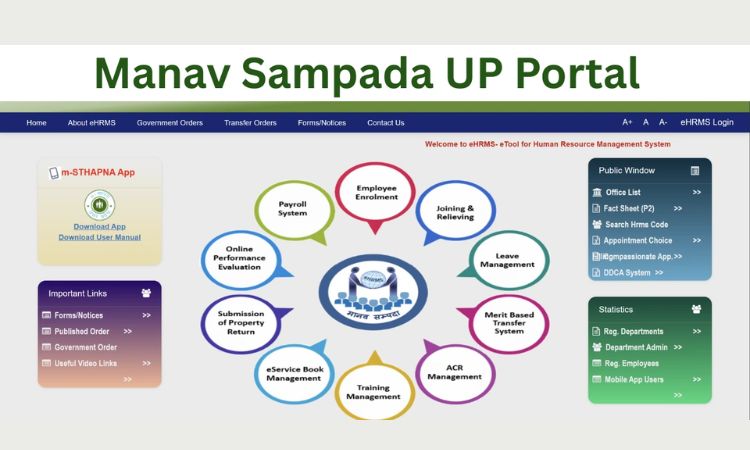
Manav Sampada UP Portal

Manav Sampada UP Portal – eHRMS Login, Status, Salary Slip & More

The Uttar Pradesh Government has launched the Manav Sampada UP Portal, a digital HR Management System that enables employees of Uttar Pradesh to have access to their HR records through an online platform. The Manav Sampada (in Hindi: मानव सम्पदा) is also known as the EHRMS (Electronic Human Resource Management System). It enables employees to view and manage their Service Record, leave applications, transfer and promotion requests, training records, and performance evaluation records online. The main goal of the Manav Sampada Portal is to provide an easy-to-use web interface to all government employees of Uttar Pradesh state departments with the goal of ensuring easy access to employee data, transparency and efficiency in HR processes. eHRMS Manav Sampada UP – Overview Feature Details Portal Name Manav Sampada UP System Type eHRMS (Human Resource Management System) Launched By Government of Uttar Pradesh Purpose Manage HR services online Users UP Government Employees Services Leave, Transfer, Promotion, Service Book Official Website ehrms.upsdc.gov.in Helpline Number 1800-180-5312 Support Email [email protected] What is UP Manav Sampada Portal Used For? The UP Manav Sampada website offers various services related to employees, including: This centralizes the HR functions of the government and eliminates large amounts of paper documentation. Also Read – ULB NDC Haryana Portal UP Manav Sampada Login: User ID and Password Explained To access the site, employees must use their credentials to log in, which is done as follows: How to check your User ID and Password? If you do not know your login credentials: Request your credentials from the HR department. Note: Employee Profiles can only be created by Departments and Self Registration is not allowed. UP Manav Sampada Login Process – A Guide to Accessing the System Step by Step To log in, follow the steps below: When logging in to the UP Manav Sampada Portal, make sure to select the specific Department Code to prevent login failure. Also Read – What is BBA in Real Estate? Leave Application in the UP Manav Sampada Portal The UP Manav Sampada Portal has a feature to provide Employees with the opportunity to submit Leave Applications online. How to Book UP Manav Sampada E-Service (Service Book Access)? Employees can access their digital service book by following these steps: The Digital Service Book contains the following information: Personal Details, Employment History, Leave History and Promotion Details. How to Check Leave/ application Status Online? To check application or leave status: This feature ensures real-time tracking of HR processes without your need to visit offices. Benefits of Manav Sampada UP Portal The Manav Sampada UP Scheme provides a number of benefits including: Overall, it improves efficiency and governance in HR operations within Government Departments. Manav Sampada UP Eligibility Criteria To access the portal, Employees will have to meet the following eligibility criteria: Only authorized personnel can access the portal. What is EHRMS in Manav Sampada UP? EHRMS (Electronic Human Resource Management System) is the digital platform of Manav Sampada UP. It manages and lists: This system allows the UP Government to improve and modernise the management of Government Employees digitally. Helpline Number and Contact Details for Manav Sampada UP For Support regarding Technical Issues or Login Issues related to the UP Manav Sampada Portal, please use the following Official Support Channels: These channels provide support for password reset, login problems, and technical errors. Why Manav Sampada UP Is Important for Government Employees? The Manav Sampada UP portal helps to modernize HR operations for government departments. By eliminating manual processes, it reduces time, reduces corruption, and improves accountability. Conclusion For government workers in Uttar Pradesh, the Manav Sampada UP portal is a revolutionary digital platform that streamlines HR administration. The system guarantees convenience and transparency in everything from service book access and status tracking to login and leave applications. Employees are empowered by the portal’s EHRMS-powered features, which enable prompt record access and effective service delivery. To enjoy hassle-free HR services, register through your department if you qualify and begin using UP Manav Sampada right now. FAQs
NDC Haryana Portal

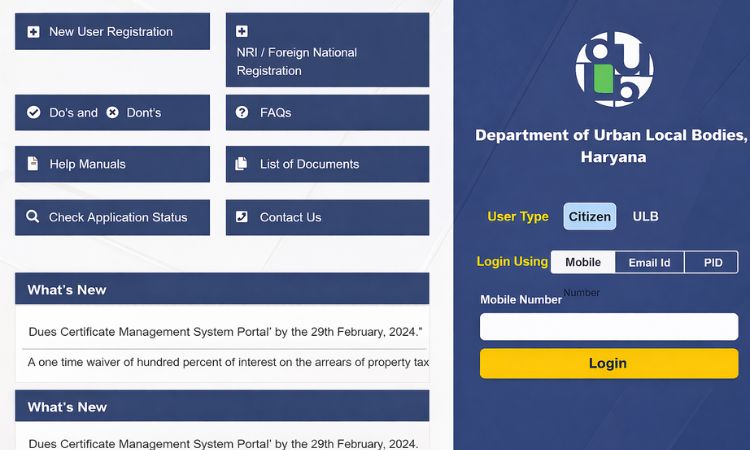
ULB NDC Haryana Portal – Login, Status, Property Tax & More

With the increasing digital transformation of governance in India, the state governments are depending on centralised systems to collect all the information required for greater Transparency, Improved Efficiency and Enhanced Delivery of Government Services. NDC Haryana plays a crucial role in this ecosystem by acting as a structured digital platform that supports data management, monitoring, and governance functions across urban local bodies (ULBs) and departments in Haryana. This blog is intended to provide a thoroughly factual and comprehensive overview of the NDC Haryana System, including the purpose for which it exists, its unique attributes and features, and an explanation of how different types of users engage with and utilize this digital platform. What is NDC Haryana? NDC Haryana is the term used to describe the ‘National Data Centre’-enabled digital framework. It enables the government of Haryana to collect, manage, analyse, monitor and analyse urban governance information, municipal services information and other information that is required to effectively manage municipal administration. It is designed to complement national initiatives in digital governance and provide a foundation for evidence supported decision-making both at state and local levels. The NDC Haryana Platform is primarily an enabling tool for government officials, urban local bodies, and other government identified users to document the progress made in delivering services and/or completing various projects and ensuring compliance with the State and Central Government schemes. Also Read – What is BBA in Real Estate? Objectives/Purposes of Haryana NDC The core objectives of Haryana NDC include: By integrating multiple data points into a single system, the platform reduces the needs for  manual processes and improves administrative efficiency. NDC Portal Haryana The NDC Portal of Haryana serves as a centralised platform for all Individuals to access the Haryana NDC System, i.e. the Haryana NDC Portal. The Haryana NDC Portal aggregates and combines the Data of all Urban and Municipal Governance Departments into a single dashboard. Some of the Primary features of the Haryana NDC Portal: The Haryana NDC Portal facilitates uniformity in data submissions, while also allowing higher authorities to monitor the progress of districts and cities. Explore Premium Residential Projects in Gurgaon Projects Location M3M Mansion Sector-113, Gurgaon M3M Crown Sector-111, Gurgaon Hero Homes The Palatial Sector-104, Gurgaon Suncity Monarch Sector-78, Gurgaon Whiteland Westin Residences Sector-103, Gurgaon Signature Global Sarvam Sector-37D, Gurgaon NDC Haryana Login: How Access Works? The Haryana NDC Login System is only available to authorized users. Access credentials are issued by the relevant department or by the state authority that operates the platform. The Steps to Login: How to Create a User Account on NDC Haryana Portal? To access municipal services (property tax payment, downloading certificates, viewing details) through the NDC Haryana website, users must create an account on the NDC portal. Steps to Register as a New User on NDC Portal Haryana: How to Find Your Property ID (PID) on NDC Haryana Portal? Property Identification Number (PID) on the NDC Haryana portal The PID (Property ID) is assigned to every registered property and is a unique number identifying each property with respect to Urban Local Bodies (ULB) in the State of Haryana. It is required for online property tax payments as well as for any downloading of certificates. What is a PID in relation to the NDC Haryana Portal? How to Locate Your PID number on the NDC Portal? Importance of the PID Number in relation to the NDC Haryana Portal How to Make Online Property Tax Payment on NDC Haryana Portal? To make a payment on the NDC Haryana Portal, all Property Owners can now pay their Municipal Property Tax on-line and not have to go into the ULB office(s) for the same. These are the Steps for making online Property Tax Payments Benefits of Online Property Tax Payment through NDC Haryana Portal How to Download No Dues Certificate (NDC) from NDC Haryana Portal – Step-by-Step Process? A No Dues Certificate is an official confirmation from the State Government of Haryana that the property has no outstanding legal liabilities for property taxes. A No Dues Certificate may be needed to transfer ownership of a property to an individual via a Mutation or via the sale of a property, and as proof of ownership in a court of law. To obtain a No Dues Certificate NDC, the following two conditions must be met: Follow the Steps Below to Obtain A No Dues Certificate NDC How the No-Due Certificate is Utilized in Haryana? ULB Haryana NDC: Role of Urban Local Bodies ULB Haryana NDC is the partnership among Urban Local Bodies (such as a municipal corporation, a council, and a committee) and the ULB Framework of NDC. Urban Local Bodies are responsible for: Because of ULB Haryana NDC integration, the state government gains a clear, real-time picture of urban performance across cities and towns. Also Read – What is RERA in Real Estate? Importance of NDC Haryana for Urban Governance NDC Haryana has significant implications because it will make it easier for multi administrative layered governments to conduct business. Key benefits include: The platform supports Haryana’s broader vision of digital governance and smart urban management. Data Security and Compliance Considering the sensitive nature of government data, the NDC Haryana portal adheres to established security standards, which include controlled access to data, encrypted data storage and routine audits of our systems. Only authorized users have access to view and alter data to ensure compliance with government IT and data protection standards. Future Scope of Haryana NDC With the evolution of Digital Governance, Haryana NDC will continue to grow in terms of scope. This growth will include the integration of more departments, the use of advanced analytical methods, use of GIS based monitoring tools, and further, improved interoperability between state/NDC and national platforms at the central level; thereby, hopefully improving decision making within the state and urban planning. Conclusion The NDC Haryana portal acts as an extensive data-driven, digital infrastructure for delivering property-related municipal services across the State of Haryana. As a centralised digital resource for the delivery...
Griha Pravesh Muhurat in 2026

Griha Pravesh Muhurat in 2026 – Auspicious Dates, Nakshatra & More

A Griha Pravesh Muhurat is more than a chosen time, it is a holy alignment of planetary positions and energies meant to bring peace, abundance, and positive vibrations into your new home. These planetary positions change every second, which is why it’s important to understand them and align your griha Pravesh muhurat accordingly. In traditions where celestial influences are honoured, selecting the right muhurat for house entry in 2026 can set a lasting foundation of stability and joy. This guide explores the best auspicious dates and timings in 2026, explains the role of Nakshatras (stars), and gives you practical and spiritual insight to plan a memorable beginning.  What is Griha Pravesh Muhurat? When you first step into a new house, ancient seers believed that cosmic energies decides your domestic harmony and well-being. A Graha Parvesh Muhurat draws on the panchang (Hindu calendar), planetary positions (Grahas), and Nakshatras to select a time when celestial forces most favors peace,growth, peace, and balance in your home. Timing your house entry ritual during such an auspicious window is believed to invite blessings, reduce negative influences, and align your life with positive rhythms.  Also Read – Simple and Easy Rangoli Designs Types of Griha Pravesh Ceremonies There are three main types of Griha Pravesh pujas: How to Pick the Timings? Every moment carries a different energy power influenced by: Properly aligning the Graha Parvesh Muhurat in 2026 will enhance the auspiciousness of your event; however, if you don’t take into consideration the cosmic timing or align properly with your birth chart (Janma Kundli), it may result in poorly aligned events initially. The best way to determine the Graha Parvesh Muhurat you choose is by consulting both an experienced astrologer as well as your Janma Kundli. Best Auspicious Dates & Timings for Griha Pravesh Muhurat in 2026 Here’s a practical calendar of auspicious opportunities throughout 2026- including early year options to mid-year and later favourable timings.  Griha Pravesh Muhurat in February 2026 The best day for Griha Pravesh Muhurat in February 2026 is as follows: These clusters are widely regarded as auspicious for house entry rituals in February 2026.  Griha Pravesh Muhurat in March 2026 The best day for Griha Pravesh in March 2026 is as follows: These early March windows bring light, positive mood shifts, and a sense of continuity.  Griha Pravesh Muhurat in April 2026 The best day for Griha Pravesh Muhurat in April 2026 is as follows: Griha Pravesh Muhurat in May 2026 The auspicious day for Griha Pravesh in May 2026 is as follows: Griha Pravesh Muhurat in June 2026 The best day for Griha Pravesh Muhurat in June 2026 is as follows: July 2026 Griha Pravesh Muhurat The best day for Griha Pravesh in July 2026 is as follows: Griha Pravesh Muhurat in August 2026 No auspicious Griha Pravesh dates available this month Griha Pravesh Muhurat in Septmeber 2026 No auspicious Griha Pravesh dates available this month Griha Pravesh Muhurat in October 2026 No auspicious Griha Pravesh dates available this month November 2026 Griha Pravesh Muhurat The best day for Griha Pravesh Muhurat in November 2026 is as follows: Griha Pravesh Muhurat in December 2026 The best day for Griha Pravesh Muhurat in December 2026 is as follows: Best Nakshatra for Griha Pravesh in 2026 Choosing dates by Nakshatra is considered key to positive spiritual influence. Some Nakshatras are traditionally more supportive of beginnings, peace, and stability: When these stars are present during your Graha Parvesh Muhurat, they align universe’s vibrations toward lasting positive well-being of all family members.  Tips When Choosing Muhurat After July How to Select Your Best Griha Pravesh Muhurat in 2026?  1. Reach Out to Your Panchang: Check the Panchang for local auspicious dates to determine your location’s specific auspicious date and time.  2. Find the Nakshatra Present: Ensure that your Nakshatra aligns with your specific time frame and matches up with the auspicious date and time listed on your Panchang.  3. Avoid Inauspicious Periods: When researching dates and times, check for the existence of Chaturmas, Adhikamasa, and also for potential celestial retrogrades that may occur during the selected windows of 2026.  4. Consider Location & Tradition: Times shift with longitude and latitude.  5. Look Up Your Birth Chart: Have a professional numerologist help you align the timing of the entering of your new house/apartment with your birth chart to create a more accurate birth chart for the entering of your new home. Why These 2026 Windows Are Special? The 2026 year will be a great time for entering into your new home due to the many lunar phases and star placements in your favour. For instance: The period of Jan to July will provide the best emotional equilibrium, an increase in financial abundance and prosperity, stability in family unity, and a more stable environment for future generations to live and grow up within. Conclusion Griha Pravesh Muhurat is not merely a calendar date; it opens the doorway to the truly positive energies that can fill every room of your dwelling. A Griha Pravesh Muhurat creates the most synchronistic energy for your home’s spiritual and emotional blueprints and serves as a blueprint of your home, allowing it to create a global culture of peace, abundance, joy, and connection to celestial bodies and the cosmos. Through the winter months and into the spring and summer of 2026, there will be many opportunities for additional Griha Pravesh Muhurat ceremonies to open the doors of a new chapter in one’s life in connection to the astrological energies available at that time. Read On – 7 Horse Painting Vastu FAQs
7 Horse Painting Vastu

7 Horse Painting – Direction, Vastu Importance & More

The 7 running Horses Painting is one of the most popular and powerful symbols of Vastu and Feng-Shui used in Indian homes and offices. When placed in the appropriate manner, it attracts success, speed, prosperity, harmony and positive energy. It is also a part of the ancient symbolism and VSU Shastra of Indian Culture that symbolises continuous growth and progress without hindrance. This article will discuss the seven horse paintings, the benefits of the 7 horse painting, the ideal direction to place the horse painting in your home, different variations of seven running horses paintings, paintings with a sunrise, sunset or moon, ideal rooms for placement, things to check before buying, and other equally powerful alternative paintings. 7 Horse Painting Meaning The meaning of the Seven Horses Painting can be traced back to Hinduism, mythology, and Vedic Symbolism in India. Seven is a special number and is the basis of the paintings’ meaning. Seven is: In Hindu Philosophy, the Seven Horses forms connection with Lord Surya (The Sun God). The Sun God rides in a Chariot pulled by seven horses representing energy, speed, discipline, and constant movement. The interrelation of the Seven Horses, therefore provides the following Five Qualities: The paintings depict the Seven Horses running together, thus representing the optimal balance and harmony for all aspects of growth within a Human Being – Personal (Physical/Health), Professional, Emotional, and Spiritual. Also Read – Simple and Easy Rangoli Designs For Home 7 Running Horses: Importance of Motion A painting of seven running horses is far more powerful than static or standing horses. This movement is more powerful and signifies: According to Vastu shastra, horses should always be shown moving forward, never backward or standing still. Forward-facing horses represent confidence, ambition, and success. Seven Horses Painting Vastu: Importance and Placement In Seven Horses Painting Vastu, the painting is believed to activate positive energy (prana) and remove obstacles from life. It Encourages Transformation within one’s life, and Therefore, is Extremely Beneficial for New Homeowners, New Business Owners, those changing Careers, and for those who feel Stagnated/stuck in career or life in general. 7 Horse Painting Vastu Benefits Some of the major seven Horses Painting Vastu benefits include: If you are feeling stagnant or are experiencing a lengthy delay of progressing in life, a Seven Horses Painting may be advisable. 7 Running Horses Painting Vastu Direction in House The proper Vastu direction in your home is extremely important to obtain the most benefits. Best Direction Directions to Avoid Note: The horses should always be shown running into the house, not away from it. Seven Horses Painting with Sunrise, Sunset, and Moon Seven Horses Painting with Sunrise A 7 Horse Painting with a sunrise symbolizes: This painting would be beneficial for individuals who are beginning a new phase in their lives, whether it is a new job, new business, or new home. Seven Horses Painting with Sunset A Seven Horses Painting with sunset represents: A sunset painting may have the visual appeal, however, a sunset painting should be chosen with caution because it represents closure rather than the ability to expand. Sunset paintings are better suited within an office than in a residential home. Seven Horses Painting with Moon The Seven Horses Painting with moon benefits include: This is an excellent choice for creative individuals looking for success and emotional balance. This is a nice choice if you have school going kids. Where Should You Place Seven Horses Painting? Is It Okay to Put It in the Living Room? Yes, this painting is recommended for use in your living room. It has a positive effect on the entire family, providing ambition and prosperity. Is It Okay to Put It in the Bedroom? The Seven Horses Painting is not typically recommended for use in a bedroom, as the fast-moving energy of the horses could create conflicting energies with the desire for peace and relaxation. If you want to have it in your bedroom, look to find a version of the painting that has softer/hired horses and less dramatic elements Office or Study Room The Seven Horses Painting is great to hang in any part of an office or study area because the Seven Horses Painting promotes harmonious working and career advancement. Specially if you chose the moon one, study or office room is the best place for it. Benefits of Putting a Picture of Seven Horses in a New Home Placing a Seven Horses Painting in your new home is believed to: This painting is often given as a housewarming gift because of its ancient wisdom and benefits. Seven Types of Horse Paintings You Can Choose From Things to Check Before Choosing a Seven Horses Painting Before buying, check these: Other Paintings as Popular as Seven Horses Painting If You Are Considering Other Options, You May Consider: Each of these holds strong symbolic value similar to the Seven Horses Painting. Significance of Seven Horses Painting in Modern Homes Beyond Vastu, the Seven Horses Painting has become a statement of ambition and elegance in modern interiors. It blends spiritual symbolism with aesthetic appeal, making it suitable for both traditional and contemporary homes. Conclusion Seven Horse Paintings are more than just beautiful pieces of art; they also represent the continued growth and development of humankind through the use of creativity, resourcefulness, teamwork, communication and determination to achieve a collective goal. When chosen thoughtfully and placed according to Seven Horses Painting Vastu, it can transform the energy of your home or office. From understanding its meaning to selecting the right direction, style, and setting, this painting continues to remain a timeless Vastu favourite for those seeking success, balance, and forward momentum in life. Whether you are moving into a new home or looking to invite growth and harmony, seven horse paintings remain popular choices for those wishing to find harmony and balance within their lives. FAQs
You have been successfully Subscribed! Ops! Something went wrong, please try again.

About Us

Brokersaathi, where we redefine the real estate landscape. Established in 2023, we are more than just a company, we are your trusted partner in navigating the dynamic world of real estate. Our commitment goes beyond transactions. We are here to empower you with a suite of services that elevate your real estate experience.
©2026 BS Brokersaathi. All rights reserved

©2024- All Right Reserved. Designed and Developed by  Blaze Themes