
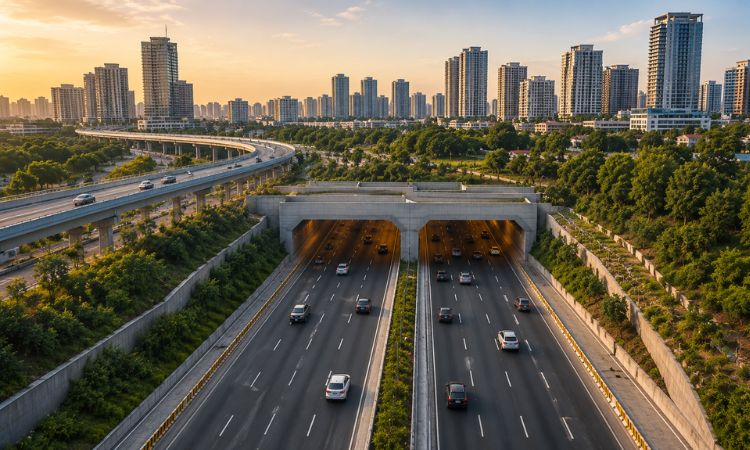

On July 1, the Cabinet Committee on Economic Affairs (CCEA), led by Prime Minister Narendra Modi, cleared an 8.1-kilometre, six-lane road tunnel that will connect the Dwarka Expressway to Nelson Mandela Marg in Vasant Kunj. The cost of this project is Rs 6,969.67 crore.
Union Minister Ashwini Vaishnaw shared the news at a press briefing, confirming that the project falls under NH-148AE and will be built using the Hybrid Annuity Model, or HAM for short.
In simple terms, this means a private company will build the tunnel and the government will pay them back over time, rather than handing over the entire cost upfront. It’s a model that’s become fairly common for big infrastructure projects in India these days.
The Journey: From Shiv Murti to Vasant Kunj
The tunnel will begin at the Shiv Murti interchange on the Dwarka Expressway and end just before the junction of Nelson Mandela Marg and Mahipalpur-Chhatarpur Road.
Out of the full 8.1 km stretch, about 6.3 km will form the main road, while the rest covers approach ramps, retaining walls, elevated sections, and regular at-grade roads.
Here’s the part that’s genuinely impressive from an engineering standpoint: a 3.14-km underground twin-tube tunnel will run right beneath Delhi’s Southern Ridge, one of the city’s last remaining green lungs.
To pull this off without tearing up the forest above, engineers will use Tunnel Boring Machines, or TBMs. This technology lets crews dig deep underground while barely disturbing what’s happening on the surface.
Roughly 1.98 km of that stretch passes directly below the ridge, which is why the government has been quick to point out that this approach was chosen specifically to protect the forest cover rather than bulldoze through it.
Why This Route Matters So Much
Those who live in Delhi know about traffic problem. This particular stretch, connecting the western side of the city to the south, has long been a bottleneck for anyone travelling to or from Gurugram, Dwarka, IGI Airport, or the Delhi-Gurugram border areas.
Once this tunnel is functional, it will link the Urban Extension Road-II (UER-II) and the Dwarka Expressway directly to Vasant Kunj.
That’s expected to bring real relief to commuters heading from Munirka and Chhattarpur towards Terminal 3 of the airport, and to anyone shuttling between Gurugram and South Delhi on a regular basis.
The project doesn’t stop at just the tunnel either. It also includes a 1.8-km elevated road along Nelson Mandela Marg to ease congestion where the tunnel exits, an additional flyover connecting Chhatarpur to Mahipalpur, and an elevated U-turn for vehicles heading toward Chhatarpur. All of these smaller pieces are designed to work together so traffic doesn’t just shift from one jam to another.
The Bigger Picture: A Connected NCR
What makes this project more interesting is how it fits into a larger puzzle. The National Highways Authority of India (NHAI) is also working on a separate elevated corridor between AIIMS and Mahipalpur.
Once that corridor links up with this new tunnel, the plan is to connect it further with the Barapullah elevated road.
If everything falls into place, this would create a nearly continuous high-speed corridor stretching from West Delhi through South Delhi, all the way to East Delhi, and onward to Ghaziabad and Noida.
That’s a genuinely big deal for a city where cross-town travel usually means picking your least-bad option among several traffic-choked roads.
Jobs, Timelines, and What Happens Next
Beyond easing traffic, the government is also framing this as a jobs project. Officials estimate the construction phase will generate close to 7.54 lakh person-days of direct employment, along with another 9.8 lakh person-days of indirect work.
That covers everything from tunnel engineers and machine operators to the smaller businesses that tend to spring up around any large construction site.
As for timing, officials have indicated the project should be completed within five years of work beginning. Given that the proposal itself has reportedly been in discussion for more than five years before finally getting Cabinet approval, many Delhi residents will understandably want to see shovels in the ground before getting too excited about the timeline.
If you regularly drive between West Delhi, Gurugram, and South Delhi, or if you’re frequently making airport runs, this project is worth keeping an eye on.
It’s not going to fix Delhi’s traffic overnight, and five years is a long time to wait. But the combination of a forest-friendly tunnelling method, a broader plan to connect multiple parts of the NCR, and a fairly detailed rollout involving flyovers and elevated roads suggests this isn’t just another announcement destined to gather dust.
For now, commuters will have to keep navigating the current traffic near Mahipalpur and Vasant Kunj a little longer. But there’s finally a concrete plan, a budget, and a timeline attached to a problem that’s frustrated Delhi drivers for years.